- Home
- Tajweed
The Quran
Tajweed: What Tajweed Is, Why It Matters and How to Learn the Quran With Tajweed
The science of reciting the Quran as it was revealed: its meaning, its ruling, its main topics and a clear path to learning it
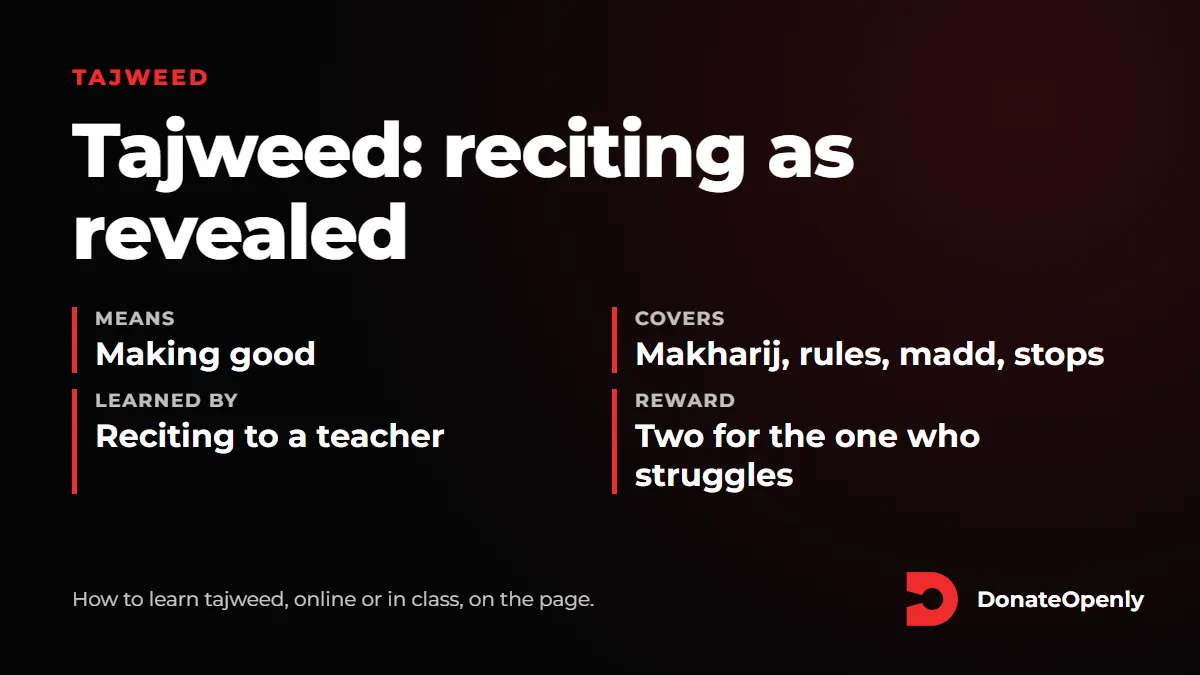
Tajweed is the set of rules for reciting the Quran correctly: giving every letter its right sound from its right place, with the right length, weight and nasal sound. The word comes from jawwada, “to make good”. Tajweed is not a style or a melody; it is how the Quran was recited by the Prophet ﷺ and taught to his companions, passed down from teacher to student ever since. Here is what tajweed covers, why it matters and how to learn it step by step.
What is tajweed?
أَوۡ زِدۡ عَلَيۡهِ وَرَتِّلِ ٱلۡقُرۡءَانَ تَرۡتِيلًا ٤
aw zid ʿalayhi warattili l-qur'āna tartīlan
Or add to it, and recite the Qur’ān with measured recitation.
Tajweed means making the recitation good, giving each letter its due. Scholars describe it as reciting every letter from its point of articulation (makhraj), with its qualities (sifat), and applying the rules that come from the letters around it.
What tajweed covers
- Makharij: where each letter is pronounced: throat, tongue, lips or nose.
- Sifat: the qualities of letters, such as heavy or light, whispered or voiced.
- Rules of noon and meem: when they are clear, merged, hidden or changed.
- Madd: how long to stretch a vowel: two, four, five or six counts.
- Waqf: where to stop and start, guided by the marks in the mushaf.
Quran and tajweed: why tajweed matters
Arabic letters that sound close to an English ear are different letters. Saying a light Ha for a heavy one, or a short vowel for a long one, can change a word’s meaning. Tajweed protects the meaning as well as the beauty of the Quran.
Is tajweed obligatory?
Scholars of recitation teach that reciting without clear mistakes that change words or meaning is required of every Muslim who recites, while studying the detailed theory of tajweed is a communal duty that some must carry. Finer points are a matter of perfecting the recitation. Do what you can, keep improving, and ask your own teacher how this applies to you.
A reward for the effort
No one should stop reciting because their tajweed is weak. The Prophet ﷺ promised two rewards to the one who recites with difficulty (Sahih al-Bukhari and Sahih Muslim).
How to learn tajweed
- Start with the letters: learn to say each letter from its place. See pronouncing Arabic letters.
- Finish a qaida: the last lessons of a noorani qaida introduce the first rules.
- Learn the main rules: noon sakinah and tanween, meem sakinah, ghunnah, qalqalah and madd. They are set out in plain English in tajweed rules.
- Recite to a teacher: tajweed is learned by ear. Books explain the rules; a teacher makes you able to do them.
- Listen to a precise reciter: Mahmoud Khalil al-Husary is a favourite of tajweed teachers for his slow, exact recitation. See Quran recitation.
Quran with tajweed: colour-coded mushafs
Some printed Qurans colour the letters where a rule applies, so you can see a ghunnah or a long madd before you reach it. They are a useful aid for learners; the key at the front of each copy explains its colours.
Learning tajweed online
Online tajweed classes work well when the teacher can hear you clearly and correct each mistake. Before you sign up, check:
- The teacher’s training: many teachers hold an ijazah, a licence to teach recitation passed from teacher to student.
- One-to-one time: you learn by reciting, not only by listening to a lecture.
- A trial lesson: see whether the teacher corrects you, kindly and precisely.
- For children: keep the camera on, stay nearby and choose a teacher who is open about how lessons are run.
How long does it take to learn tajweed?
With a weekly lesson and daily practice, most learners can apply the main rules within six months to a year. Perfecting recitation is a lifelong journey.
Written for DonateOpenly from the sources it cites, and awaiting review by ulama. Dates are worked out from the Islamic calendar and depend on the moon sighting.
Choose a charity, then give on its own website
Every registered UK Muslim charity has a page on DonateOpenly: what it does, where its work reaches people and where donors review it.
Tajweed: questions
What does tajweed mean?
Tajweed means “making good”: reciting the Quran with each letter from its right place, with its right qualities, lengths and rules.
Is tajweed compulsory?
Avoiding clear mistakes that change the words or meaning of the Quran is required of every reciter; studying the detailed rules is a communal duty. Follow your own teacher on the details.
Can I learn tajweed by myself?
You can learn the rules from a book or video, but you need someone to hear your recitation. Even a short weekly lesson with a teacher makes a big difference.
What is the difference between tajweed and tarteel?
Tajweed is the set of rules for correct recitation. Tarteel is reciting slowly and clearly, as commanded in Quran 73:4, with those rules applied.
What is a tajweed Quran?
A tajweed Quran is a printed mushaf that colours the letters where a tajweed rule applies, such as ghunnah or a long madd, with a key explaining the colours.