- Home
- Pronouncing Arabic letters
Learn Arabic
Pronouncing Arabic Letters: Makharij, the Throat Letters and the Sounds English Does Not Have
The five areas of the mouth and throat, the six throat letters, the heavy letters and simple drills for the hardest sounds
Pronouncing Arabic letters well starts with the makharij: the places in the throat, tongue, lips and nose where each sound is made. Most Arabic letters are close to English sounds; the challenge is a small group made deep in the throat (Ayn, heavy Ha, Ghayn, Kha) and four heavy letters said with a full mouth. Learn where each sound comes from, practise them in pairs that differ by one sound, and recite to someone who can hear you. Here is how.
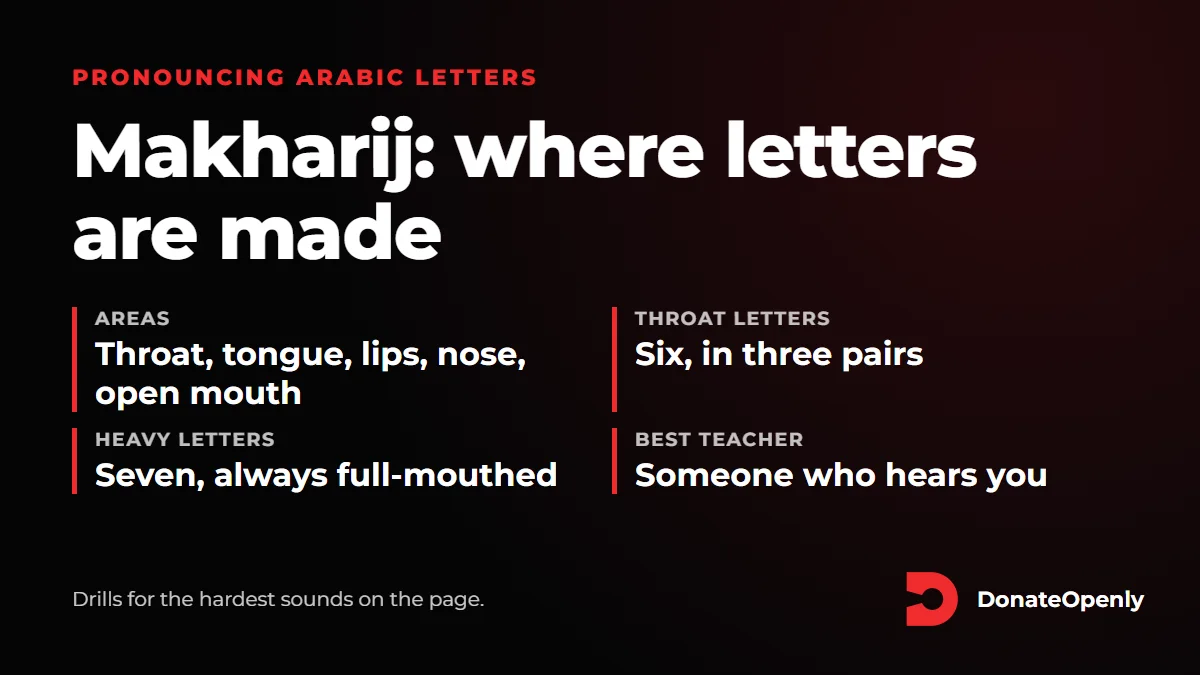
Makharij: where Arabic letters are pronounced
Scholars of tajweed group the points of articulation (makharij) into five areas. Many teach seventeen exact points within them.
- The open space (al-jawf): the mouth and throat as a whole, for the three long vowels.
- The throat (al-halq): six letters, from deep to near.
- The tongue (al-lisan): most letters, from Qaf and Kaf at the back to Ta, Dal and the th sounds at the tip.
- The lips (ash-shafatan): Fa, Ba, Mim and Waw.
- The nose (al-khayshum): ghunnah, the nasal sound of Noon and Meem.
Find a letter’s makhraj
Put a sukun on the letter with a hamza and fatha before it (ab, at, a’) and say it. Where the sound stops is its makhraj.
The Arabic throat letters
Six letters come from the throat, in three pairs:
- Deepest: hamza and light Ha: the catch in “uh-oh”, and the h of “hat”.
- Middle: Ayn and heavy Ha: Ayn is a tight, voiced squeeze; heavy Ha is a strong, breathy h, like fogging a mirror with a narrowed throat.
- Nearest: Ghayn and Kha: Ghayn is a soft gargle, close to the French r; Kha is rougher, like the ch in Scottish “loch”.
Drills for the throat letters
Say light Ha and heavy Ha in turn: ha, Ha, ha, Ha. Then hamza and Ayn: a, ’a. Practise with words you know: hamd (praise) with heavy Ha, Allah with light Ha, ’ilm (knowledge) with Ayn.
Heavy letters and sounds English lacks
Seven letters are always heavy: the back of the tongue rises and the mouth fills, as if saying “o” around the letter. They are Kha, Sad, Dad, Ghayn, heavy Ta, Qaf and Za.
- Sad vs Sin: s, but heavy. Compare sabr (patience) with Sad and salam with Sin.
- Ta vs Ta: the heavy Ta in tayyib (good) against the light Ta in tawbah.
- Dad: a heavy d made with the side of the tongue against the upper molars, the sound Arabic is named for.
- Za and Dhal: both like th in “this”, Za heavy and Dhal light.
- Qaf vs Kaf: Qaf from the very back of the mouth, Kaf further forward.
Tha and Dhal
Speakers of some languages say s or z for these. They are the th in “think” (Tha) and the th in “this” (Dhal), made with the tongue tip between the teeth.
How to practise the Arabic letter sounds
- Listen first: play the letters or a slow recitation and copy one letter at a time. The surah pages here play every verse aloud.
- Use pairs: practise letters that learners mix up (Sin and Sad, light and heavy Ha, Hamza and Ayn) side by side.
- Watch and feel: a mirror shows your lips; a hand on the throat feels the throat letters.
- Record yourself: compare with a reciter and fix one sound a week.
- Recite to a teacher: the surest way, as the Quran has always been taught. See tajweed.
Written for DonateOpenly from the sources it cites, and awaiting review by ulama. Dates are worked out from the Islamic calendar and depend on the moon sighting.
Choose a charity, then give on its own website
Every registered UK Muslim charity has a page on DonateOpenly: what it does, where its work reaches people and where donors review it.
Pronouncing Arabic letters: questions
What are makharij?
Makharij are the points where Arabic letters are pronounced: the throat, the tongue, the lips, the nose and the open space of the mouth for the long vowels.
What are the Arabic throat letters?
The six throat letters are hamza, light Ha, Ayn, heavy Ha, Ghayn and Kha, in three pairs from the deepest part of the throat to the nearest.
How do I pronounce Ayn?
Tighten the middle of your throat and let a voiced sound squeeze through, as if starting to gag gently. Copy a teacher or recording; it comes with practice.
Which Arabic letters are heavy?
Seven letters are always heavy: Kha, Sad, Dad, Ghayn, heavy Ta, Qaf and Za, remembered as khussa daghtin qiz.
Does pronunciation change the meaning in Arabic?
Yes. Swapping a light Ha for a heavy one, or Sin for Sad, can turn one word into another, which is why tajweed teaches each letter’s place.