- Home
- Quran recitation
The Quran
Quran Recitation: How to Learn to Recite the Quran Clearly and Beautifully, Step by Step
A step-by-step path from the letters to fluent recitation, the manners of reading, murattal and mujawwad, and where to listen to every surah
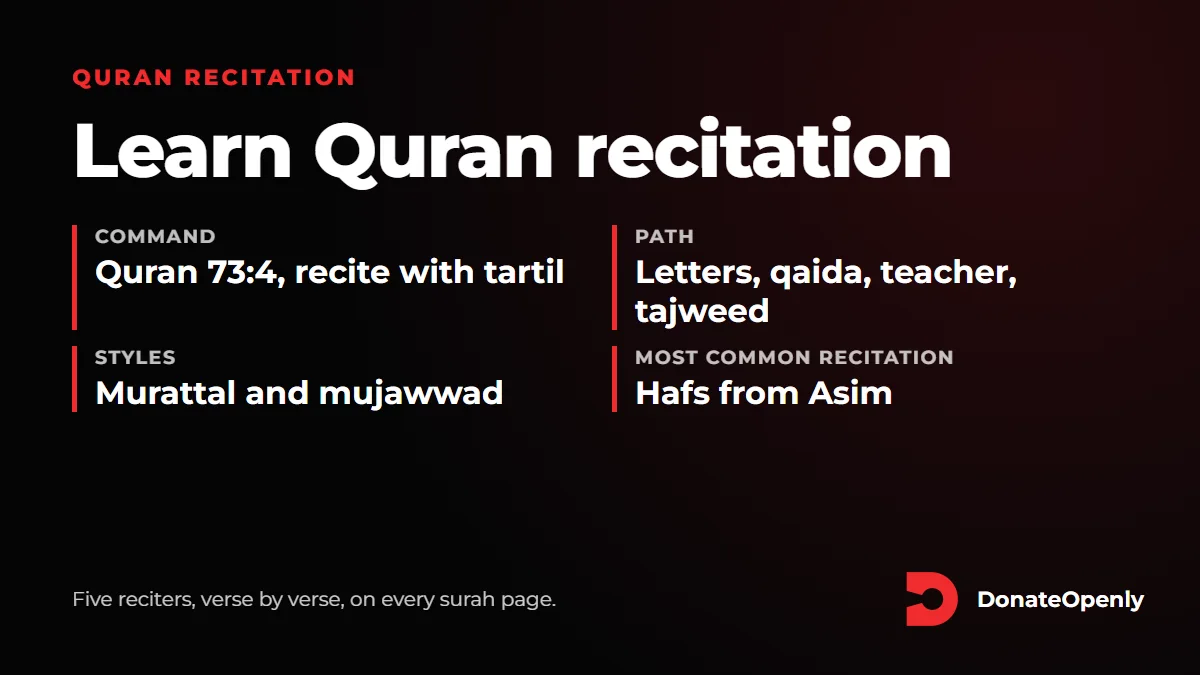
Quran recitation (tilawah) is reading the Quran aloud in Arabic, clearly and correctly, the way the Prophet ﷺ taught it to his companions. Allah commands it in the Quran itself: “recite the Quran with measured recitation” (73:4). Anyone can learn, at any age: learn the letters and a qaida, read to a teacher, learn the main tajweed rules and listen every day to a good reciter. Below is a step-by-step path, the manners of recitation, the styles you will hear and where to listen to every surah.
Quran recitation in the Quran and Sunnah
أَوۡ زِدۡ عَلَيۡهِ وَرَتِّلِ ٱلۡقُرۡءَانَ تَرۡتِيلًا ٤
aw zid ʿalayhi warattili l-qur'āna tartīlan
Or add to it, and recite the Qur’ān with measured recitation.
Tartil, the word in this verse, means reciting slowly and distinctly, giving each letter its due. It is the opposite of rushing.
Why Muslims recite the Quran
- Learning and teaching it: “The best of you are those who learn the Quran and teach it” (Sahih al-Bukhari 5027).
- An intercessor: “Read the Quran, for it will come on the Day of Resurrection as an intercessor for its companions” (Sahih Muslim 804).
- Every effort counts: the one who reads with difficulty, stumbling, has two rewards (Sahih al-Bukhari and Sahih Muslim).
- In every prayer: recitation is part of salah itself, beginning with Surah Al-Fatiha.
How to learn Quran recitation, step by step
- Learn the letters and their sounds: start with the Arabic alphabet and how to pronounce each letter.
- Finish a qaida: a noorani qaida takes you from single letters to reading the Quran’s words.
- Read to a teacher: the Quran has always been passed on from mouth to ear. A teacher hears mistakes you cannot hear yourself.
- Learn the main tajweed rules: ghunnah, madd, qalqalah and the rules of noon sakinah. See tajweed rules.
- Listen and repeat: choose one reciter, play a verse, pause and repeat it. Every surah page here plays the recitation verse by verse.
- Recite a little every day: two pages a day completes the 604-page Madinah mushaf in under a year.
- Record yourself: compare your recording with your reciter and note one thing to fix each week.
Reciting beautifully
The Prophet ﷺ encouraged beautifying the Quran with the voice, as reported by Abu Dawud and others. Work on steady breath, a calm pace and clear letters first. A beautiful voice follows the rules; it never bends them for a melody.
The manners of reciting the Quran
فَإِذَا قَرَأۡتَ ٱلۡقُرۡءَانَ فَٱسۡتَعِذۡ بِٱللَّهِ مِنَ ٱلشَّيۡطَٰنِ ٱلرَّجِيمِ ٩٨
fa-idhā qarata l-qur'āna fa-is'taʿidh bil-lahi mina l-shayṭāni l-rajīmi
So when you recite the Qur’ān, [first] seek refuge in Allāh from Satan, the expelled [from His mercy].
Before reciting, seek refuge in Allah from Satan, as this verse commands: A’udhu billahi minash-shaytanir-rajim. Then say Bismillah at the start of every surah except At-Tawbah.
- Wudu: most scholars hold that you need wudu to touch a mushaf. Reciting from memory without wudu is allowed. Views differ on reciting during menstruation or in a state of major impurity, so ask your own scholar.
- Place and posture: a clean place, sitting with respect, and facing the qiblah when you can.
- Pace: slow enough to say every letter, with pauses at verse ends.
- Reflection: stop at a verse of mercy to ask for it, and at a verse of warning to seek refuge.
- Listening: when the Quran is recited, listen in silence (Al-A’raf 7:204).
When your mind wanders
The Prophet ﷺ taught a companion who was troubled by distraction in his prayer and recitation to seek refuge in Allah from Satan. Hisn al-Muslim records it under its own chapter.
Styles of Quran recitation
- Murattal: measured, steady recitation, used in prayer and in most complete recordings.
- Mujawwad: slow and melodic, with long breaths, recited at gatherings. The great Egyptian reciters, such as Qari Abdul Basit, made it famous.
- Tahqiq, tadwir and hadr: three speeds, all with full tajweed. Tahqiq is the slowest, used for teaching; tadwir is the middle pace; hadr is swift, used by those revising long portions.
The qira’at: authentic ways of reciting
The Quran was taught in several authentic modes of recitation, and ten qira’at are recognised by scholars. Each differs in small points of sound and, rarely, wording, all going back to the Prophet ﷺ. Hafs from Asim is the most widespread today; Warsh from Nafi’ is heard across North and West Africa, and Qalun from Nafi’ in Libya and parts of Tunisia.
The best Quran recitation to listen to
There is no single best Quran recitation in the world: the best is the one that moves you and that you can learn from. Every surah page here offers five reciters, verse by verse:
- Mishary Rashid Alafasy: clear and warm, ideal for daily listening. See Qari Mishary.
- Mahmoud Khalil al-Husary: slow and exact, a favourite of tajweed teachers.
- Muhammad Siddiq al-Minshawi: deeply moving and precise.
- Abdul Basit Abdus Samad: the famous voice of Egypt; hear his Surah Ar-Rahman.
- Hani ar-Rifai: gentle, steady and easy to follow.
Quran recitation on YouTube and apps
Choose recordings that name the reciter, play complete surahs and add no music or effects. For more names, including the imams of Makkah, see famous qaris.
Written for DonateOpenly from the sources it cites, and awaiting review by ulama. Dates are worked out from the Islamic calendar and depend on the moon sighting.
Choose a charity, then give on its own website
Every registered UK Muslim charity has a page on DonateOpenly: what it does, where its work reaches people and where donors review it.
Quran recitation: questions
What is Quran recitation called in Arabic?
Reciting the Quran is called tilawah or qira’ah. Tajweed is the set of rules that make the recitation correct, and tartil is reciting it slowly and clearly.
How can I learn Quran recitation at home?
Learn the letters with a qaida, read to a teacher in person or online, learn the main tajweed rules and listen and repeat after one reciter every day. Little and often works best.
Who has the best Quran recitation in the world?
Many are loved worldwide, including Mishary Alafasy, Abdul Basit Abdus Samad, al-Husary, al-Minshawi, and the imams of Makkah such as Sudais and Shuraim. The best for you is the one you understand and learn from.
How do I start reciting the Quran?
Seek refuge in Allah first. Allah says: “So when you recite the Qur’an, [first] seek refuge in Allah from Satan, the expelled” (Quran 16:98). Then say Bismillah and begin.
Do I need wudu to recite the Quran?
Most scholars require wudu to touch a mushaf, but you may recite from memory without it, and many scholars also allow reading from a phone screen. Follow your own scholar where views differ.
What is the reward for reciting the Quran?
The Prophet ﷺ said: “Read the Quran, for it will come on the Day of Resurrection as an intercessor for its companions” (Sahih Muslim 804).