- Home
- Nazar ki dua (evil eye dua)
Duas
Nazar Ki Dua: Dua for Evil Eye Protection in Arabic, English and Roman Urdu (Bad Nazar and Nazre Bad Ki Dua)
The Prophet’s dua against the evil eye, daily protection from the Quran, what to say when you admire something, and how to treat nazar
Nazar ki dua, the dua against the evil eye, is the one the Prophet ﷺ said over his grandsons al-Hasan and al-Husayn: “U‘idhukuma bikalimatillahit-tammah, min kulli shaytanin wa hammah, wa min kulli ‘aynin lammah”, “I place you both in the protection of Allah’s perfect words from every devil, every harmful creature and every evil eye” (Sahih al-Bukhari). For everyday protection the Sunnah adds Surah Al-Falaq and Surah An-Nas. Below are the duas in Arabic, transliteration and English, what to say so you do not give nazar, how to treat nazar from the Sunnah, and what Islam does not teach about it.
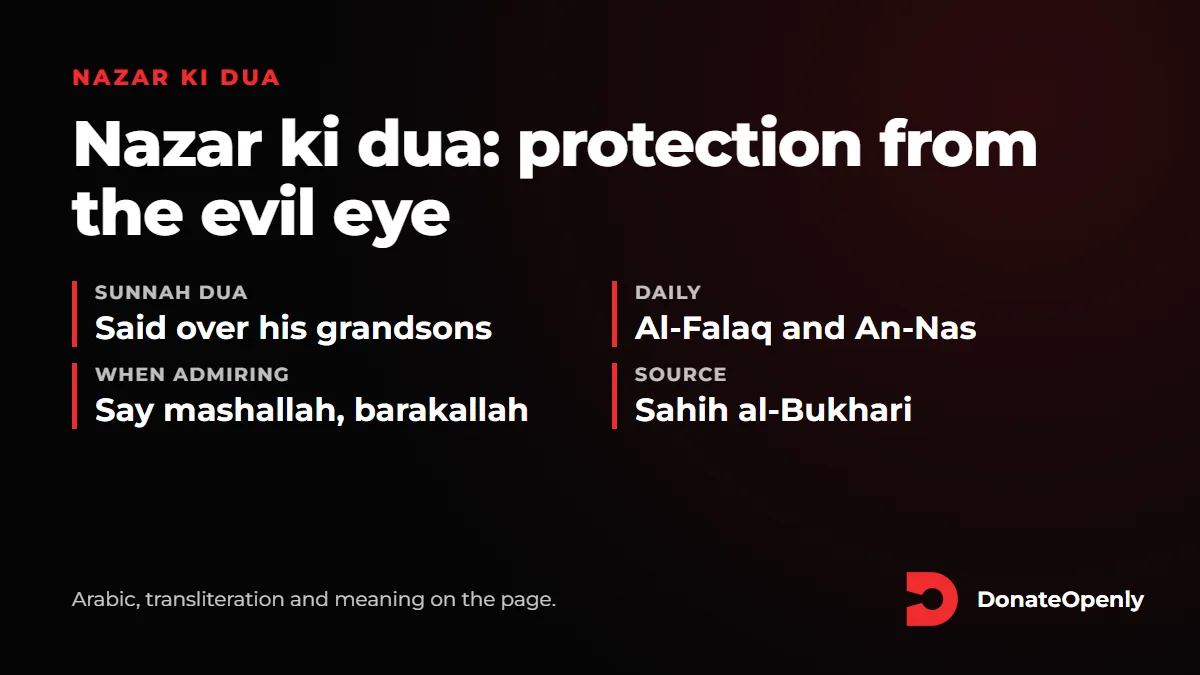
Nazar ki dua: the Prophet’s dua against the evil eye
كَانَ رَسُولُ اللَّهِ صلى الله عليه وسلم يُعَوِّذُ الحَسَنَ وَالحُسَينَ رضي الله عنهما ((أُعِيذُكُمَا بِكَلِمَاتِ اللَّهِ التَّامَّةِ مِنْ كُلِّ شَيْطَانٍ وَهَامَّةٍ، وَمِنْ كُلِّ عَيْنٍ لاَمَّةٍ)).
(Ibn AAabbas related that the Messenger of Allah used to commend Al-Hasan and Al-Husayn to Allah’s protection, saying:(OAAeethukuma bikalimatil-lahit-tammah, min kulli shaytanin wahammah, wamin kulli AAaynin lammah.))
(Ibn AAabbas related that the Messenger of Allah used to commend Al-Hasan and Al-Husayn to Allah’s protection, saying:(I commend you two to the protection of Allah’s perfect words from every devil, vermin, and every evil eye.))
Ibn Abbas reported that the Prophet ﷺ sought Allah’s protection for al-Hasan and al-Husayn with these words, and said that Ibrahim used them for his sons Isma‘il and Ishaq (Sahih al-Bukhari).
Nazar ki dua meaning in English
- U‘idhukuma bikalimatillahit-tammah: I place you both in the protection of Allah’s perfect words,
- min kulli shaytanin wa hammah: from every devil and every harmful creature,
- wa min kulli ‘aynin lammah: and from every evil eye.
Saying it for one child or for yourself
U‘idhukuma is for two people. For one boy many say u‘idhuka, for one girl u‘idhuki, and for yourself a‘udhu (I seek protection). The rest of the words stay the same.
Nazar se bachne ki dua: protection every morning and evening
قُلۡ أَعُوذُ بِرَبِّ ٱلۡفَلَقِ ١ مِن شَرِّ مَا خَلَقَ ٢ وَمِن شَرِّ غَاسِقٍ إِذَا وَقَبَ ٣ وَمِن شَرِّ ٱلنَّفَّٰثَٰتِ فِي ٱلۡعُقَدِ ٤ وَمِن شَرِّ حَاسِدٍ إِذَا حَسَدَ ٥
qul aʿūdhu birabbi l-falaqi min sharri mā khalaqa wamin sharri ghāsiqin idhā waqaba wamin sharri l-nafāthāti fī l-ʿuqadi wamin sharri ḥāsidin idhā ḥasada
Say, "I seek refuge in the Lord of daybreak From the evil of that which He created And from the evil of darkness when it settles And from the evil of the blowers in knots And from the evil of an envier when he envies."
قُلۡ أَعُوذُ بِرَبِّ ٱلنَّاسِ ١ مَلِكِ ٱلنَّاسِ ٢ إِلَٰهِ ٱلنَّاسِ ٣ مِن شَرِّ ٱلۡوَسۡوَاسِ ٱلۡخَنَّاسِ ٤ ٱلَّذِي يُوَسۡوِسُ فِي صُدُورِ ٱلنَّاسِ ٥ مِنَ ٱلۡجِنَّةِ وَٱلنَّاسِ ٦
qul aʿūdhu birabbi l-nāsi maliki l-nāsi ilāhi l-nāsi min sharri l-waswāsi l-khanāsi alladhī yuwaswisu fī ṣudūri l-nāsi mina l-jinati wal-nāsi
Say, "I seek refuge in the Lord of mankind, The Sovereign of mankind, The God of mankind, From the evil of the retreating whisperer - Who whispers [evil] into the breasts of mankind - From among the jinn and mankind".
((بِسْمِ اللَّهِ الَّذِي لاَ يَضُرُّ مَعَ اسْمِهِ شَيْءٌ فِي الْأَرْضِ وَلاَ فِي السّمَاءِ وَهُوَ السَّمِيعُ الْعَلِيمُ)) (ثلاثَ مرَّاتٍ).
(Bismil-lahil-lathee la yadurru maAAas-mihi shay-on fil-ardi wala fis-sama-i wahuwas-sameeAAul-AAaleem. (three times).)
(In the name of Allah with whose name nothing is harmed on earth nor in the heavens and He is The All-Seeing, The All-Knowing.’(three times))
The Prophet ﷺ used to seek refuge from the jinn and from the evil eye of people until Al-Falaq and An-Nas, the first two texts above, were revealed; then he used them and left the rest (reported by at-Tirmidhi).
- Al-Ikhlas, Al-Falaq and An-Nas: three times in the morning, three times in the evening, and before sleep. See the 4 Quls.
- Ayat al-Kursi: after each prayer and before sleep.
- Bismillahil-ladhi la yadurru…: the third text above, three times morning and evening. Uthman ibn Affan reported that nothing will harm the one who says it (Abu Dawud and at-Tirmidhi).
Nazar na lagne ki dua: say mashallah and barakallah
((إِذَا رَأَى أَحَدُكُم مِنْ أَخِيهِ، أَوْ مِنْ نَفْسِهِ، أَوْ مِنْ مَالِهِ مَا يُعْجِبُهُ [فَلْيَدْعُ لَهُ بِالْبَرَكَةِ] فَإِنَّ الْعَيْنَ حَقٌّ)).
If you see anything of your brother that pleases you, or of his person or of his property [then ask Allah to bless him in it] for the envious eye is real.
وَلَوۡلَآ إِذۡ دَخَلۡتَ جَنَّتَكَ قُلۡتَ مَا شَآءَ ٱللَّهُ لَا قُوَّةَ إِلَّا بِٱللَّهِۚ إِن تَرَنِ أَنَا۠ أَقَلَّ مِنكَ مَالٗا وَوَلَدٗا ٣٩
walawlā idh dakhalta jannataka qul'ta mā shāa l-lahu lā quwwata illā bil-lahi in tarani anā aqalla minka mālan wawaladan
And why did you, when you entered your garden, not say, 'What Allāh willed [has occurred]; there is no power except in Allāh'? Although you see me less than you in wealth and children,
The evil eye can come from admiration as much as from envy, even from someone who loves you. So when something pleases you, in your child, a friend’s new home or your own success, ask Allah to bless it, as the first text above teaches: Barakallahu fih (may Allah bless it) or Allahumma barik ‘alayh (O Allah, bless him).
The verse from Surah Al-Kahf teaches the words “Ma sha Allah, la quwwata illa billah”: what Allah willed has happened; there is no power except with Allah. Saying them reminds you that the good came from Allah. See mashallah meaning.
Nazar utarne ki dua: what to do when someone has the evil eye
- Recite over them: Al-Fatiha, Ayat al-Kursi, Al-Ikhlas, Al-Falaq and An-Nas, then blow lightly over them, or into your hands and wipe over them. This is the ruqyah of the Sunnah.
- Say the Prophet’s dua: the nazar ki dua above, over the child or adult.
- If the person is known: in Sahih Muslim the Prophet ﷺ said “The evil eye is real” and “If you are asked to wash, then wash”: the one whose look caused harm washes, and the water is poured over the person affected.
What Islam does not teach
Burning chillies, hanging lemons and chillies over the door, evil-eye beads and black threads are not from the Quran or the Sunnah. Protection is sought from Allah alone, with His words.
See a doctor as well
Many things blamed on nazar, such as tiredness, a baby who will not settle or a loss of appetite, can have medical causes. Make dua and seek treatment too.
Nazar ki dua in the Quran
وَإِن يَكَادُ ٱلَّذِينَ كَفَرُواْ لَيُزۡلِقُونَكَ بِأَبۡصَٰرِهِمۡ لَمَّا سَمِعُواْ ٱلذِّكۡرَ وَيَقُولُونَ إِنَّهُۥ لَمَجۡنُونٞ ٥١ وَمَا هُوَ إِلَّا ذِكۡرٞ لِّلۡعَٰلَمِينَ ٥٢
wa-in yakādu alladhīna kafarū layuz'liqūnaka bi-abṣārihim lammā samiʿū l-dhik'ra wayaqūlūna innahu lamajnūnun wamā huwa illā dhik'run lil'ʿālamīna
And indeed, those who disbelieve would almost make you slip with their eyes [i.e., looks] when they hear the message, and they say, "Indeed, he is mad." But it is not except a reminder to the worlds.
Commentators such as Ibn Kathir mention these verses when explaining that the evil eye is real, and some people recite them for nazar. The protection the Sunnah itself teaches is Al-Falaq, An-Nas and the duas above. See the last ayat of Surah Al-Qalam for these verses in full.
Written for DonateOpenly from the sources it cites, and awaiting review by ulama. Dates are worked out from the Islamic calendar and depend on the moon sighting.
Choose a charity, then give on its own website
Every registered UK Muslim charity has a page on DonateOpenly: what it does, where its work reaches people and where donors review it.
Nazar ki dua (evil eye dua): questions
What is nazar ki dua?
It is the dua the Prophet ﷺ said over al-Hasan and al-Husayn: “U‘idhukuma bikalimatillahit-tammah, min kulli shaytanin wa hammah, wa min kulli ‘aynin lammah” (Sahih al-Bukhari).
Is the evil eye real in Islam?
Yes. The Prophet ﷺ said: “The evil eye is real” (Sahih al-Bukhari and Sahih Muslim). Protection is sought from Allah through the Quran and the Sunnah duas.
Which surah protects from nazar?
Surah Al-Falaq and Surah An-Nas. The Prophet ﷺ used them for protection from the evil eye after they were revealed (at-Tirmidhi), along with Al-Ikhlas and Ayat al-Kursi.
How do I remove nazar from a child?
Recite Al-Fatiha, Ayat al-Kursi and the three Quls and blow lightly over the child, and say the Prophet’s dua over them. If the child is unwell, see a doctor as well.
What should I say so I do not give someone nazar?
When something pleases you, ask Allah to bless it: “Barakallahu fih” or “Ma sha Allah, la quwwata illa billah”.
What is nazar ki dua in English?
“I place you in the protection of Allah’s perfect words from every devil, every harmful creature and every evil eye.”
Is there a çocuk nazar duası (dua for a child’s nazar)?
The Turkish search for a child’s nazar dua leads to the same Sunnah dua above, which the Prophet ﷺ said over his grandsons.