- Home
- Namaz e janaza
Death and janazah
Namaz e Janaza: How to Pray the Janazah Prayer Step by Step (Four Takbirs)
The funeral prayer: four takbirs said standing, with no ruku or sujood, and what is said after each
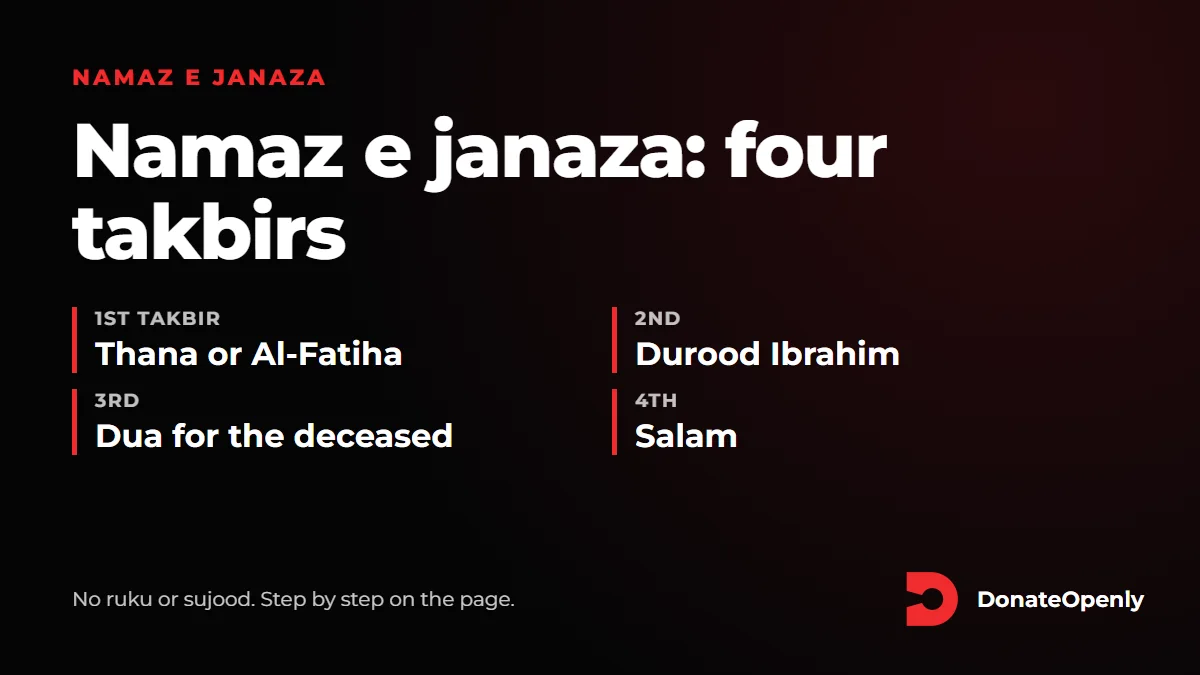
Namaz e janaza, the funeral prayer, is prayed standing with four takbirs and no ruku or sujood. After the first takbir comes praise (or Al-Fatiha), after the second the salawat on the Prophet (peace be upon him), after the third a dua for the deceased, and after the fourth the salam. It is a communal obligation: if some Muslims pray it, the rest are free of sin, but its reward is great. Here is namaz e janaza ka tarika step by step, in the Hanafi way and the other schools’, with the duas from Hisn al-Muslim.
Namaz e janaza ka tarika step by step
- Before: wudu, face the qibla, stand in rows behind the imam (an odd number of rows is preferred). The deceased lies in front of the imam, who stands by the chest of a man and the middle of a woman.
- Niyat: the funeral prayer for this deceased, for Allah, behind this imam.
- 1st takbir: raise the hands and say Allahu akbar; fold them. Hanafi: recite the thana (“Subhanakallahumma…”). Shafi’i and Hanbali: recite A‘udhu billah, Bismillah and Al-Fatiha.
- 2nd takbir: say Allahu akbar without raising the hands (Hanafi; others raise them). Recite durood Ibrahim.
- 3rd takbir: say Allahu akbar. Make dua for the deceased (below).
- 4th takbir: say Allahu akbar. Pause briefly; some add a short dua.
- Salam: turn to the right and then the left (Hanafi, Shafi’i); one salam to the right (Hanbali, Maliki).
Everything is said quietly by the followers; the imam says the takbirs and salam aloud.
Janazah prayer duas from Hisn al-Muslim
((اللَّهُمَّ اغْفِرْ لِحَيِّنَا وَمَيِّتِنَا، وَشَاهِدِنَا وَغَائِبِنَا، وَصَغِيرِنَا وَكَبيرِنَا، وَذَكَرِنَا وَأُنْثَانَا. اللَّهُمَّ مَنْ أَحْيَيْتَهُ مِنَّا فَأَحْيِهِ عَلَى الْإِسْلاَمِ، وَمَنْ تَوَفَّيْتَهُ مِنَّا فَتَوَفَّهُ عَلَى الإِيمَانِ، اللَّهُمَّ لاَ تَحْرِمْنَا أَجْرَهُ، وَلاَ تُضِلَّنَا بَعْدَهُ)).
(Allahummagh-fir lihayyina wamayyitina washahidina, wagha-ibina, wasagheerina wakabeerina, wathakarina wa-onthana. Allahumma man ahyaytahu minna fa-ahyihi AAalal-islam, waman tawaffaytahu minna fatawaffahu AAalal-eeman, allahumma la tahrimna ajrah, wala tudillana baAAdah.)
(O Allah, forgive our living and our dead, those present and those absent, our young and our old, our males and our females. O Allah, whom amongst us You keep alive, then let such a life be upon Islam, and whom amongst us You take unto Yourself, then let such a death be upon faith. O Allah, do not deprive us of his reward and do not let us stray after him.)
((اللَّهُمَّ اغْفِرْ لَهُ وَارْحَمْهُ، وَعَافِهِ، وَاعْفُ عَنْهُ، وَأَكْرِمْ نُزُلَهُ، وَوَسِّعْ مُدْخَلَهُ، وَاغْسِلْهُ بِالْمَاءِ وَالثَّلْجِ وَالْبَرَدِ، وَنَقِّهِ مِنَ الْخَطَايَا كَمَا نَقَّيْتَ الثَّوْبَ الأَبْيَضَ مِنَ الدَّنَسِ، وَأَبْدِلْهُ دَاراً خَيْراً مِنْ دَارِهِ، وَأَهْلاً خَيْراً مِنْ أَهْلِهِ، وَزَوْجَاً خَيْراً مِنْ زَوْجِهِ، وَأَدْخِلْهُ الْجَنَّةَ، وَأَعِذْهُ مِنْ عَذَابِ القَبْرِ [وَعَذَابِ النَّارِ])).
(Allahummagh-fir lahu warhamh, waAAafihi, waAAfu AAanh, wa-akrim nuzulah, wawassiAA mudkhalah, waghsilhu bilma-i waththalji walbarad, wanaqqihi minal-khataya kama naqqaytath-thawbal-abyada minad-danas, wa-abdilhu daran khayran min darih, wa-ahlan khayran min ahlih wazawjan khayran min zawjih, wa-adkhilhul-jannah, wa-aAAithhu min AAathabil-qabr, waAAathabin-nar)
(O Allah, forgive and have mercy upon him, excuse him and pardon him, and make honourable his reception. Expand his entry, and cleanse him with water, snow, and ice, and purify him of sin as a white robe is purified of filth. Exchange his home for a better home, and his family for a better family, and his spouse for a better spouse. Admit him into the Garden, protect him from the punishment of the grave and the torment of the Fire.)
After the third takbir, say one or more of these. The first, “Allahummaghfir li hayyina wa mayyitina…”, is the dua most Hanafi mosques teach for an adult; the second is the dua Awf ibn Malik heard the Prophet make at a funeral (Sahih Muslim). For a woman, the words “lahu” and “hu” change to “laha” and “ha”.
For a child, and for the other duas, see dua for namaz e janaza.
If you do not know the duas
Say what you can sincerely: “Allahummaghfir lahu warhamhu”, O Allah, forgive him and have mercy on him. Then learn the duas.
Joining namaz e janaza late
- Hanafi: wait for the imam’s next takbir and join with it. After his salam, say the takbirs you missed before the body is lifted.
- Shafi’i and Hanbali: join straight away and follow the order from your own first takbir, completing what you missed after the imam’s salam.
Janazah in absence and at the grave
The Prophet prayed the funeral prayer in absence for the Negus (Sahih al-Bukhari and Sahih Muslim). The Shafi’i and Hanbali schools allow this generally; the Hanafi and Maliki schools do not. Someone who missed the prayer may pray it at the grave within a period, by the Shafi’i and Hanbali view.
The reward of attending a janazah
The Prophet said: whoever attends a funeral until the prayer, for him is one qirat; whoever attends until the burial, for him are two qirats. He was asked what two qirats are and said: like two great mountains (Sahih al-Bukhari and Sahih Muslim).
Women may pray janazah. Attending the prayer is a right of one Muslim over another. After the prayer, see Islamic burial for the burial itself, and what to say when someone dies.
Written for DonateOpenly from the sources it cites, and awaiting review by ulama. Dates are worked out from the Islamic calendar and depend on the moon sighting.
Choose a charity, then give on its own website
Every registered UK Muslim charity has a page on DonateOpenly: what it does, where its work reaches people and where donors review it.
Namaz e janaza: questions
How many takbirs are in namaz e janaza?
Four, all said standing. There is no ruku or sujood.
What is said after each takbir in janazah?
1st: thana (Hanafi) or Al-Fatiha (Shafi’i, Hanbali). 2nd: durood Ibrahim. 3rd: dua for the deceased. 4th: salam.
Is janazah prayer fard?
It is a communal obligation (fard kifayah): if enough Muslims pray it, the rest are not sinful.
Do you need wudu for janazah prayer?
Yes. It is a prayer and needs wudu and facing the qibla.
What is the reward for praying janazah?
One qirat for attending until the prayer, and two for staying until the burial, each like a great mountain (Sahih al-Bukhari and Sahih Muslim).
Can women pray namaz e janaza?
Yes. Women may pray it, at the mosque or with the family.