- Home
- Islamic burial
Death and janazah
Islam Burial: How a Muslim Funeral and Burial Is Done, Step by Step, and the Islamic Grave
From the moment of death to the grave: washing, shrouding, the janazah prayer, burial facing the qibla and the duas said
In Islam, burial follows quickly after death: the body is washed (ghusl), wrapped in plain white cloth (kafan), the janazah prayer is prayed, and the body is buried in the earth on its right side, facing the qibla. Cremation is not permitted. The grave is simple and raised only a little. Here is a Muslim funeral and burial step by step, the duas said at the grave, what the Muslim grave looks like, and practical notes for families in the UK.
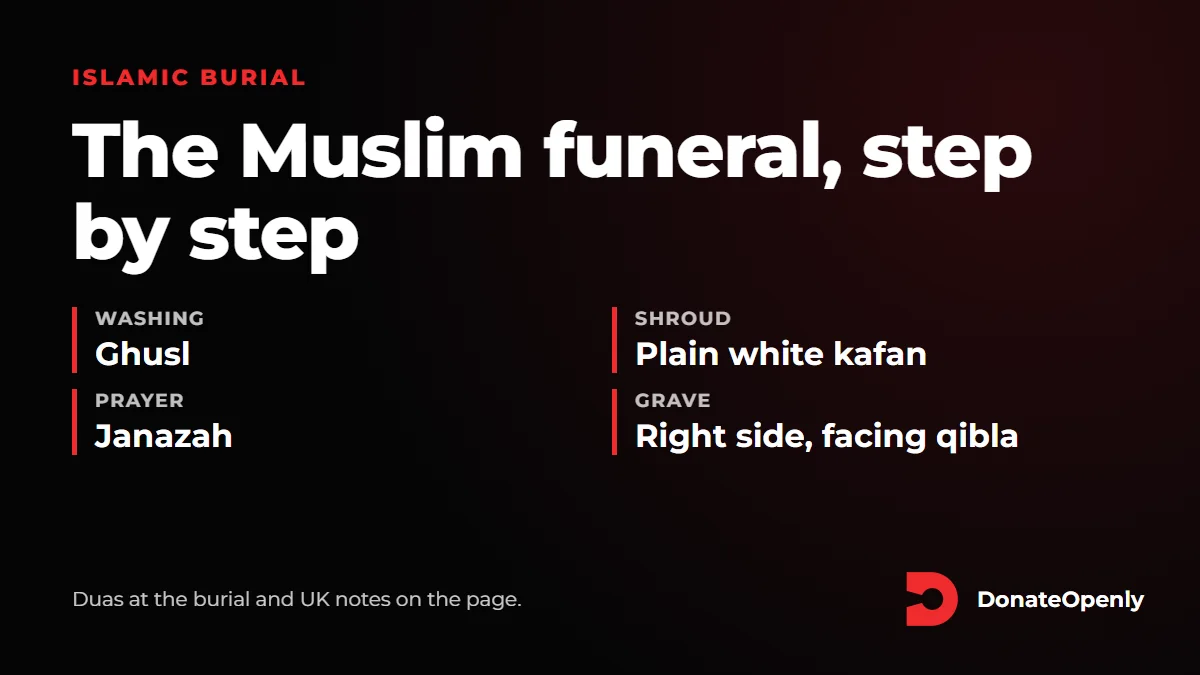
Islam burial step by step
- 1. At death: close the eyes, say the dua for the deceased, cover the body, and settle their debts and wishes promptly.
- 2. Ghusl: the body is washed an odd number of times, usually three, by Muslims of the same sex (a spouse may wash a spouse). It is done gently and privately, with wudu first. A martyr killed in battle is not washed.
- 3. Kafan: plain white cloth. The sunnah is three sheets for a man; for a woman, five pieces are usual. Perfume (camphor) may be used.
- 4. Janazah prayer: at the mosque or a prayer place. See namaz e janaza.
- 5. Carrying: walk briskly with the bier. The Prophet (peace be upon him) said hurry with the funeral (Sahih al-Bukhari and Sahih Muslim).
- 6. Burial: the body is lowered into the grave and laid on its right side facing the qibla.
- 7. Filling the grave: those present help put earth in. Many throw three handfuls.
- 8. Dua after burial: stand at the grave and ask Allah to keep the deceased firm.
Duas at the burial
((بِسْمِ اللَّهِ وَعَلَى سُنَّةِ رَسُولِ اللَّهِ)).
(Bismil-lahi waAAala sunnati rasoolil-lah.)
(In the name of Allah and upon the sunnah of the Messenger of Allah.)
((اللَّهُمَّ اغْفِرْ لَهُ، اللَّهُمَّ ثَبِّتْهُ)).
Allaahum-maghfir lahu Allaahumma thabbithu
O Allah, forgive him. O Allah, strengthen him
- Lowering the body: “Bismillahi wa ‘ala sunnati Rasulillah”, in the name of Allah and on the way of the Messenger of Allah.
- After burial: the Prophet would stand at the grave and say: ask forgiveness for your brother and ask for him to be made firm, for he is now being questioned (Sunan Abi Dawud).
The Quran at the graveside
Many recite the verse “From it We created you, and into it We will return you, and from it We will extract you another time” while filling the grave (Surah Taha 20:55).
The Islamic grave
- Lahd or shaqq: a lahd is a niche cut into the side of the grave, which the Prophet’s grave had; a shaqq is a trench in the middle, used in soft soil.
- Simple: raised about a hand span so it is known as a grave. The Prophet forbade plastering graves, building over them and sitting on them (Sahih Muslim).
- Marker: a stone or plain marker to know the grave is allowed by most scholars.
- No coffin, where the law allows; in UK cemeteries a simple coffin is sometimes required.
Visiting the grave
Visiting graves reminds us of the hereafter. On entering a graveyard, greet its people with the dua in Hisn al-Muslim: “As-salamu ‘alaykum ahlad-diyari minal-mu’minina wal-muslimin…”.
Muslim funeral customs in the UK
- Registering the death: a doctor issues a medical certificate and the death is registered with the local registrar, usually within days; many councils offer urgent registration for faith burials, including at weekends.
- The coroner: if a death is sudden or unexplained, the coroner is told. Families can ask for a quick decision and a non-invasive scan rather than a post-mortem where possible.
- Muslim funeral services: most mosques run or know a funeral service that arranges the washing, shroud, janazah and burial in a Muslim section of a cemetery. Ask your local mosque first.
- Repatriation: some families fly the body abroad; this delays burial and has costs, so many scholars encourage burial where the person died.
Afterwards, the family receives condolences for three days. See condolence message in Islam. A widow keeps her iddah of four months and ten days. See iddah.
Written for DonateOpenly from the sources it cites, and awaiting review by ulama. Dates are worked out from the Islamic calendar and depend on the moon sighting.
Choose a charity, then give on its own website
Every registered UK Muslim charity has a page on DonateOpenly: what it does, where its work reaches people and where donors review it.
Islamic burial: questions
How quickly is a Muslim buried?
As soon as possible, ideally within a day, once the washing, shrouding and janazah prayer are done.
Is cremation allowed in Islam?
No. Muslims bury their dead in the earth, as the Quran describes: “From it We created you, and into it We will return you” (Quran 20:55).
Which way does a Muslim face in the grave?
Laid on the right side, facing the qibla.
Are Muslims buried in coffins?
Islamic practice is burial in the shroud alone. Where local rules require a coffin, a simple one is used.
What does a Muslim grave look like?
Simple, raised about a hand span, without buildings over it. A plain marker to identify it is allowed by most scholars.
Can women attend a Muslim burial?
Women may attend the janazah prayer. On following the funeral to the graveside, scholars differ; many discourage it, and local mosque practice varies.