- Home
- Wudu steps
Salah
Wudu Steps: How to Do Wudu Step by Step (Ablution in Islam), the Fard of Wudu and the Dua After
The washing before prayer in order: what the Quran makes obligatory, the sunnah way, and what to say before and after
Wudu steps in order: make the intention, say Bismillah, wash your hands three times, rinse your mouth three times, rinse your nose three times, wash your face three times, wash your arms up to and including the elbows three times (right first), wipe your head once and your ears, and wash your feet up to and including the ankles three times (right first). Then say the shahadah. The Quran makes four of these obligatory (Quran 5:6); the rest are sunnah. Here is how to do wudu step by step, the fard of wudu by school, and the dua after wudu.
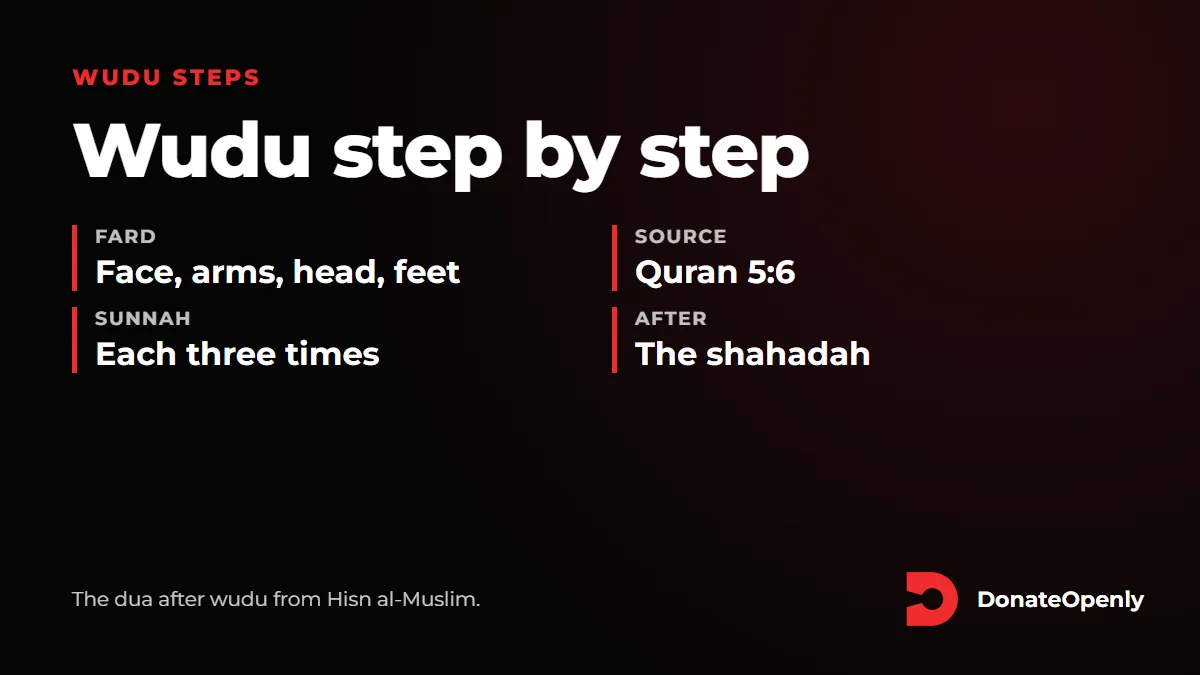
Wudu steps: how to do wudu step by step
(بِسْمِ اللَّهِ).
(Bismil-lah.)
(In the name of Allah.)
- 1. Intention: intend in your heart to make wudu for prayer.
- 2. Bismillah: say “Bismillah”, shown above.
- 3. Hands: wash both hands up to the wrists three times, between the fingers.
- 4. Mouth: rinse the mouth three times. Use a miswak or brush the teeth with a finger if you can.
- 5. Nose: sniff water into the nose with the right hand and blow it out with the left, three times.
- 6. Face: wash the whole face three times, from the hairline to the chin and from ear to ear. Run wet fingers through a thick beard.
- 7. Arms: wash the right arm from the fingertips to above the elbow three times, then the left.
- 8. Head: wipe the head once with wet hands, from the front to the back and back again.
- 9. Ears: wipe inside the ears with the index fingers and behind them with the thumbs.
- 10. Feet: wash the right foot up to and above the ankle three times, between the toes, then the left.
Do it in this order, without long gaps, and without wasting water. The Prophet (peace be upon him) made wudu with about a mudd of water, two handfuls (Sahih al-Bukhari and Sahih Muslim).
The fard of wudu
يَٰٓأَيُّهَا ٱلَّذِينَ ءَامَنُوٓاْ إِذَا قُمۡتُمۡ إِلَى ٱلصَّلَوٰةِ فَٱغۡسِلُواْ وُجُوهَكُمۡ وَأَيۡدِيَكُمۡ إِلَى ٱلۡمَرَافِقِ وَٱمۡسَحُواْ بِرُءُوسِكُمۡ وَأَرۡجُلَكُمۡ إِلَى ٱلۡكَعۡبَيۡنِۚ وَإِن كُنتُمۡ جُنُبٗا فَٱطَّهَّرُواْۚ وَإِن كُنتُم مَّرۡضَىٰٓ أَوۡ عَلَىٰ سَفَرٍ أَوۡ جَآءَ أَحَدٞ مِّنكُم مِّنَ ٱلۡغَآئِطِ أَوۡ لَٰمَسۡتُمُ ٱلنِّسَآءَ فَلَمۡ تَجِدُواْ مَآءٗ فَتَيَمَّمُواْ صَعِيدٗا طَيِّبٗا فَٱمۡسَحُواْ بِوُجُوهِكُمۡ وَأَيۡدِيكُم مِّنۡهُۚ مَا يُرِيدُ ٱللَّهُ لِيَجۡعَلَ عَلَيۡكُم مِّنۡ حَرَجٖ وَلَٰكِن يُرِيدُ لِيُطَهِّرَكُمۡ وَلِيُتِمَّ نِعۡمَتَهُۥ عَلَيۡكُمۡ لَعَلَّكُمۡ تَشۡكُرُونَ ٦
yāayyuhā alladhīna āmanū idhā qum'tum ilā l-ṣalati fa-igh'silū wujūhakum wa-aydiyakum ilā l-marāfiqi wa-im'saḥū biruūsikum wa-arjulakum ilā l-kaʿbayni wa-in kuntum junuban fa-iṭṭahharū wa-in kuntum marḍā aw ʿalā safarin aw jāa aḥadun minkum mina l-ghāiṭi aw lāmastumu l-nisāa falam tajidū māan fatayammamū ṣaʿīdan ṭayyiban fa-im'saḥū biwujūhikum wa-aydīkum min'hu mā yurīdu l-lahu liyajʿala ʿalaykum min ḥarajin walākin yurīdu liyuṭahhirakum waliyutimma niʿ'matahu ʿalaykum laʿallakum tashkurūna
O you who have believed, when you rise to [perform] prayer, wash your faces and your forearms to the elbows and wipe over your heads and wash your feet to the ankles. And if you are in a state of janābah, then purify yourselves. But if you are ill or on a journey or one of you comes from the place of relieving himself or you have contacted women and do not find water, then seek clean earth and wipe over your faces and hands with it. Allāh does not intend to make difficulty for you, but He intends to purify you and complete His favor upon you that you may be grateful.
The verse names four acts, and these are fard in every school:
- Washing the face.
- Washing the arms including the elbows.
- Wiping the head: a quarter of it (Hanafi), any part (Shafi’i), all of it (Maliki, Hanbali).
- Washing the feet including the ankles.
What the schools add
- Hanafi: the four only; intention, order and continuity are sunnah.
- Shafi’i: adds the intention and the order.
- Maliki: adds the intention, continuity without long gaps, and rubbing the limbs.
- Hanbali: adds the order and continuity, counts rinsing the mouth and nose as part of the face, and the intention as a condition.
To be safe in every view, intend, keep the order and do not pause.
Dua after wudu
(أَشْهَدُ أَنْ لاَ إِلَهَ إِلاَّ اللَّهُ وَحْدَهُ لاَ شَرِيكَ لَهُ وَأَشْهَدُ أَنَّ مُحَمَّداً عَبْدُهُ وَرَسُولُهُ..).
(Ashhadu an la ilaha illal-lahu wahdahu la shareeka lah, wa-ashhadu anna Muhammadan AAabduhu warasooluh.)
(I bear witness that none has the right to be worshipped except Allah, alone without partner, and I bear witness that Muhammad is His slave and Messenger.)
(اللَّهُمَّ اجْعَلْنِي مِنَ التَّوَّابِينَ وَاجْعَلْنِي مِنَ الْمُتَطَهِّرِينَ)
(Allahummaj-AAalnee minat-tawwabeena wajAAalnee minal-mutatahhireen.)
(O Allah, make me of those who return to You often in repentance and make me of those who remain clean and pure.)
(سُبْحانَكَ اللَّهُمَّ وَبِحَمْدِكَ، أَشْهَدُ أَنْ لاَ إِلَهَ إِلاَّ أَنْتَ، أَسْتَغْفِرُكَ وَأَتوبُ إِلَيْكَ).
(Subhanakal-lahumma wabihamdika ashhadu an la ilaha illa anta astaghfiruka wa-atoobu ilayk.)
(How perfect You are O Allah, and I praise You, I bear witness that none has the right to be worshipped except You, I seek Your forgiveness and turn in repentance to You.)
The Prophet said: whoever makes wudu well and then says the shahadah, the first text above, the eight gates of Paradise are opened for him and he may enter by whichever he wishes (Sahih Muslim). At-Tirmidhi’s narration adds the second dua. The third is also in Hisn al-Muslim for after wudu.
Two rakats after wudu
Praying two rakats after wudu with full attention is a sunnah; the Prophet heard Bilal’s footsteps in Paradise and Bilal said he prayed after every wudu (Sahih al-Bukhari and Sahih Muslim).
Wudu for women and common questions
- The steps are the same for men and women.
- Hijab: wipe the hair itself, slipping wet hands under the front of the scarf; some scholars allowed wiping over a covering that is hard to remove. Ask your scholar.
- Nail polish: it stops water reaching the nail, so remove it before wudu. Henna does not form a layer and is fine.
- Make-up: waterproof make-up that forms a layer should be removed from the face.
- Socks: wiping over leather socks (khuffs) put on with wudu is allowed for a day and a night, or three days when travelling. The schools differ on ordinary cloth socks.
- During a period: no prayer, so no wudu is needed for it.
For what ends wudu, see what breaks wudu. If there is no water, see tayammum.
Written for DonateOpenly from the sources it cites, and awaiting review by ulama. Dates are worked out from the Islamic calendar and depend on the moon sighting.
Choose a charity, then give on its own website
Every registered UK Muslim charity has a page on DonateOpenly: what it does, where its work reaches people and where donors review it.
Wudu steps: questions
What are the steps of wudu?
Intention, Bismillah, hands, mouth, nose, face, arms to the elbows, wipe the head and ears, feet to the ankles; each washed three times, right before left.
What are the fard of wudu?
Washing the face, the arms including the elbows, wiping the head, and washing the feet including the ankles (Quran 5:6). Some schools add intention, order and continuity.
What is the dua after wudu?
“Ash-hadu an la ilaha illallahu wahdahu la sharika lah, wa ash-hadu anna Muhammadan ‘abduhu wa rasuluh” (Sahih Muslim), then “Allahummaj‘alni minat-tawwabin waj‘alni minal-mutatahhirin”.
How do women do wudu?
Exactly as men do. Remove nail polish first, and wipe the hair itself under the front of the scarf.
Do I need to wash three times?
Once is the obligation; three times is the sunnah. More than three is wasteful.
Can I make wudu in the shower?
Yes, if you wash each part in order. A full ghusl also includes wudu for most purposes.