- Home
- Tayammum
Salah
Tayammum: How to Perform Tayammum Step by Step (Dry Ablution), When It Is Allowed and What Breaks It
Purifying with clean earth when water cannot be used: the Quran’s permission, the steps, and the schools side by side
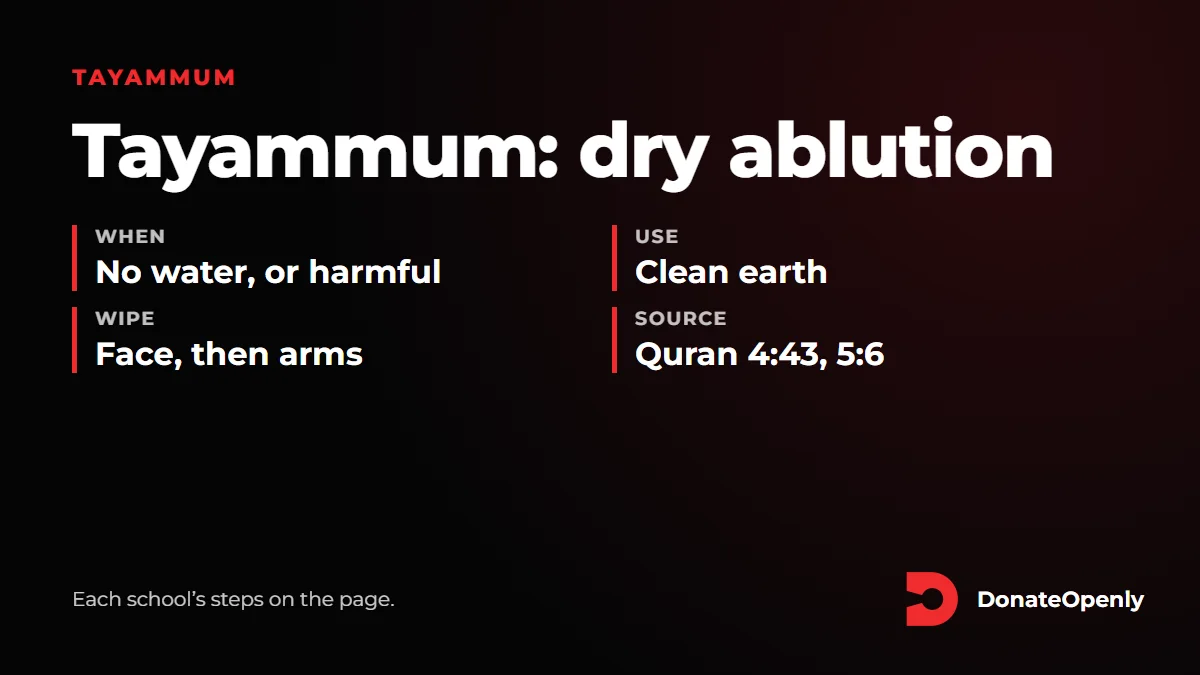
Tayammum is dry ablution: purifying for prayer with clean earth when there is no water or you cannot use it. You make the intention, strike clean earth with your palms, wipe your face, and wipe your hands and arms. It replaces both wudu and ghusl. The Quran permits it in 4:43 and 5:6, and Ammar ibn Yasir’s hadith shows how the Prophet (peace be upon him) did it. Here is how to perform tayammum step by step, the steps in each school, when it is allowed, and what breaks it.
Tayammum in the Quran
يَٰٓأَيُّهَا ٱلَّذِينَ ءَامَنُواْ لَا تَقۡرَبُواْ ٱلصَّلَوٰةَ وَأَنتُمۡ سُكَٰرَىٰ حَتَّىٰ تَعۡلَمُواْ مَا تَقُولُونَ وَلَا جُنُبًا إِلَّا عَابِرِي سَبِيلٍ حَتَّىٰ تَغۡتَسِلُواْۚ وَإِن كُنتُم مَّرۡضَىٰٓ أَوۡ عَلَىٰ سَفَرٍ أَوۡ جَآءَ أَحَدٞ مِّنكُم مِّنَ ٱلۡغَآئِطِ أَوۡ لَٰمَسۡتُمُ ٱلنِّسَآءَ فَلَمۡ تَجِدُواْ مَآءٗ فَتَيَمَّمُواْ صَعِيدٗا طَيِّبٗا فَٱمۡسَحُواْ بِوُجُوهِكُمۡ وَأَيۡدِيكُمۡۗ إِنَّ ٱللَّهَ كَانَ عَفُوًّا غَفُورًا ٤٣
yāayyuhā alladhīna āmanū lā taqrabū l-ṣalata wa-antum sukārā ḥattā taʿlamū mā taqūlūna walā junuban illā ʿābirī sabīlin ḥattā taghtasilū wa-in kuntum marḍā aw ʿalā safarin aw jāa aḥadun minkum mina l-ghāiṭi aw lāmastumu l-nisāa falam tajidū māan fatayammamū ṣaʿīdan ṭayyiban fa-im'saḥū biwujūhikum wa-aydīkum inna l-laha kāna ʿafuwwan ghafūran
O you who have believed, do not approach prayer while you are intoxicated until you know what you are saying or in a state of janābah, except those passing through [a place of prayer], until you have washed [your whole body]. And if you are ill or on a journey or one of you comes from the place of relieving himself or you have contacted women [i.e., had sexual intercourse] and find no water, then seek clean earth and wipe over your faces and your hands [with it]. Indeed, Allāh is ever Pardoning and Forgiving.
The verse, and the end of Quran 5:6, allow tayammum for the sick, the traveller and anyone who cannot find water, to lift both minor impurity (instead of wudu) and major impurity (instead of ghusl). Allah says in 5:6 that He does not intend to make difficulty for you.
When tayammum is allowed
- No water within reach, after looking for it (about a mile away in the Hanafi view).
- Illness or injury: when water would harm you or delay recovery, on a doctor’s or your reasoned judgement.
- Extreme cold with no way to warm the water, if you fear harm.
- Water needed for drinking: keep it for drinking and make tayammum.
- Fear: of an enemy, an animal or danger on the way to the water.
What to use: clean earth, sand, stone, or dust from the ground. The Hanafi and Maliki schools allow anything of the earth’s surface; the Shafi’i and Hanbali schools require dust that sticks to the hands.
How to perform tayammum step by step
- 1. Intention: intend tayammum to make prayer allowed (and say whether it replaces wudu or ghusl, in the Hanafi view).
- 2. Bismillah.
- 3. Strike: strike clean earth lightly with both palms, fingers apart. Blow or shake off the excess.
- 4. Face: wipe the whole face once with both palms.
- 5. Strike again (Hanafi, Shafi’i): strike the earth a second time.
- 6. Arms: wipe the right arm with the left palm up to and including the elbow, then the left arm with the right palm. Pass the fingers between each other.
Steps of tayammum in each school
- Hanafi and Shafi’i: two strikes, face, then arms to the elbows.
- Hanbali: one strike, face, then the hands to the wrists, following Ammar’s hadith: the Prophet struck the earth once and wiped his face and hands (Sahih al-Bukhari and Sahih Muslim).
- Maliki: one strike for the face and hands to the wrists is obligatory; a second strike and wiping to the elbows is sunnah.
What breaks tayammum
- Anything that breaks wudu (see what breaks wudu), or for a tayammum instead of ghusl, anything that requires ghusl.
- Finding water or becoming able to use it.
- Prayers per tayammum: the Hanafi school lets one tayammum serve many prayers, like wudu; the Shafi’i, Maliki and Hanbali schools require a new tayammum for each fard prayer (Hanbali: each prayer time).
If you find water after praying with tayammum, most scholars say the prayer is valid and need not be repeated. Once you can, make wudu or ghusl.
Written for DonateOpenly from the sources it cites, and awaiting review by ulama. Dates are worked out from the Islamic calendar and depend on the moon sighting.
Choose a charity, then give on its own website
Every registered UK Muslim charity has a page on DonateOpenly: what it does, where its work reaches people and where donors review it.
Tayammum: questions
What is tayammum?
Purifying for prayer with clean earth when water is missing or cannot be used. It replaces wudu and ghusl.
How do you perform tayammum?
Intend, say Bismillah, strike clean earth with your palms, wipe your face, then (with a second strike in the Hanafi and Shafi’i schools) wipe your arms to the elbows.
When can I do tayammum instead of wudu?
When there is no water, or using it would harm you through illness, injury or cold, or you need it to drink.
Is tayammum in the Quran?
Yes: “and find no water, then seek clean earth and wipe over your faces and your hands” (Quran 4:43, 5:6).
Can I do tayammum on a wall?
On a wall of stone, brick or earth, yes in the Hanafi and Maliki schools. A painted or tiled surface does not count unless it has dust on it.