- Home
- What is tawheed
Islam basics
What Is Tawheed? The Oneness of Allah, the Heart of Islam
La ilaha illallah: believing Allah is One, and worshipping Him alone
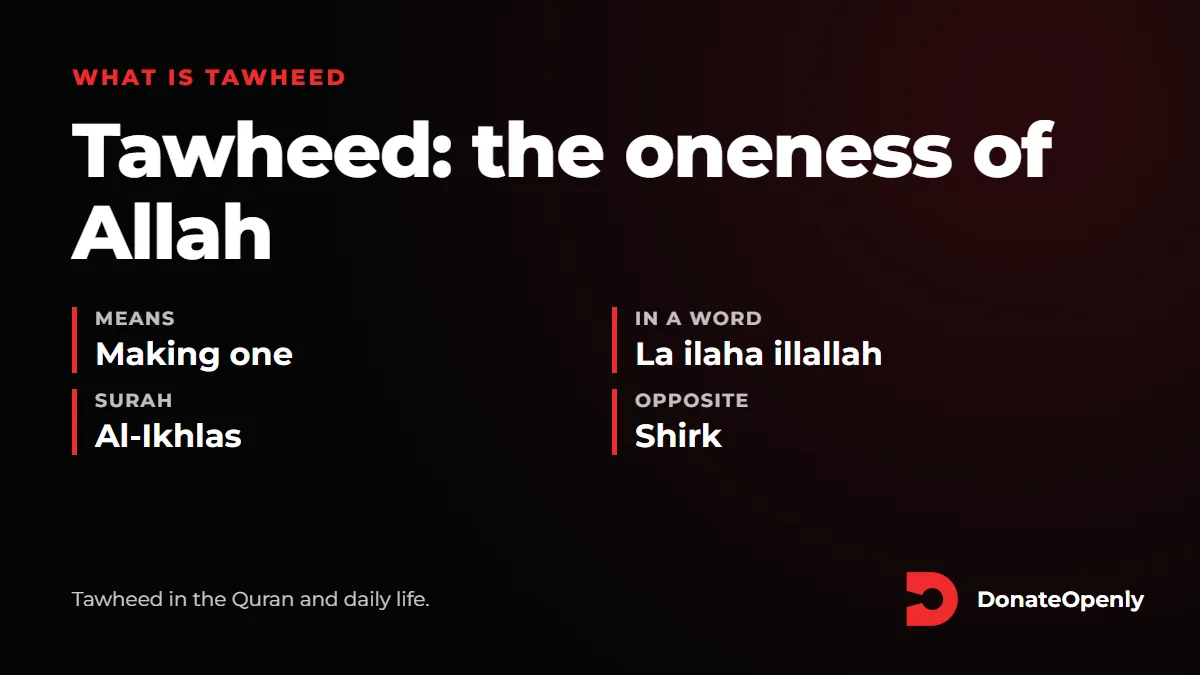
Tawheed (tawhid) means the oneness of Allah: believing that Allah is One, without partner, equal or rival, and worshipping Him alone. It is the first half of the shahada, la ilaha illallah, the message of every prophet, and the theme of Surah Al-Ikhlas, which the Prophet ﷺ said equals a third of the Quran. Its opposite is shirk, associating partners with Allah. This page explains what tawheed means, how it appears in the Quran, how scholars teach it, and what it means for daily life.
What is tawheed?
قُلۡ هُوَ ٱللَّهُ أَحَدٌ ١ ٱللَّهُ ٱلصَّمَدُ ٢ لَمۡ يَلِدۡ وَلَمۡ يُولَدۡ ٣ وَلَمۡ يَكُن لَّهُۥ كُفُوًا أَحَدُۢ ٤
qul huwa l-lahu aḥadun al-lahu l-ṣamadu lam yalid walam yūlad walam yakun lahu kufuwan aḥadun
Say, "He is Allāh, [who is] One, Allāh, the Eternal Refuge. He neither begets nor is born, Nor is there to Him any equivalent."
Tawheed comes from wahid, one. It means to make one: to single Allah out as the only Lord, the only one worshipped, and the only one with His names and attributes.
Surah Al-Ikhlas, shown above, is tawheed in four verses: Allah is One, the Eternal Refuge, who neither begets nor is born, with none equal to Him. Al-Bukhari reports the Prophet ﷺ saying it equals a third of the Quran. See Surah Al-Ikhlas.
Tawheed, tawhid, tauheed
Tawheed, tawhid, tauheed and towhid are spellings of the same word.
Tawheed in the Quran
وَإِلَٰهُكُمۡ إِلَٰهٞ وَٰحِدٞۖ لَّآ إِلَٰهَ إِلَّا هُوَ ٱلرَّحۡمَٰنُ ٱلرَّحِيمُ ١٦٣
wa-ilāhukum ilāhun wāḥidun lā ilāha illā huwa l-raḥmānu l-raḥīmu
And your god is one God. There is no deity [worthy of worship] except Him, the Entirely Merciful, the Especially Merciful.
لَوۡ كَانَ فِيهِمَآ ءَالِهَةٌ إِلَّا ٱللَّهُ لَفَسَدَتَاۚ فَسُبۡحَٰنَ ٱللَّهِ رَبِّ ٱلۡعَرۡشِ عَمَّا يَصِفُونَ ٢٢
law kāna fīhimā ālihatun illā l-lahu lafasadatā fasub'ḥāna l-lahi rabbi l-ʿarshi ʿammā yaṣifūna
Had there been within them [i.e., the heavens and earth] gods besides Allāh, they both would have been ruined. So exalted is Allāh, Lord of the Throne, above what they describe.
وَلَقَدۡ بَعَثۡنَا فِي كُلِّ أُمَّةٖ رَّسُولًا أَنِ ٱعۡبُدُواْ ٱللَّهَ وَٱجۡتَنِبُواْ ٱلطَّٰغُوتَۖ فَمِنۡهُم مَّنۡ هَدَى ٱللَّهُ وَمِنۡهُم مَّنۡ حَقَّتۡ عَلَيۡهِ ٱلضَّلَٰلَةُۚ فَسِيرُواْ فِي ٱلۡأَرۡضِ فَٱنظُرُواْ كَيۡفَ كَانَ عَٰقِبَةُ ٱلۡمُكَذِّبِينَ ٣٦
walaqad baʿathnā fī kulli ummatin rasūlan ani uʿ'budū l-laha wa-ij'tanibū l-ṭāghūta famin'hum man hadā l-lahu wamin'hum man ḥaqqat ʿalayhi l-ḍalālatu fasīrū fī l-arḍi fa-unẓurū kayfa kāna ʿāqibatu l-mukadhibīna
And We certainly sent into every nation a messenger, [saying], "Worship Allāh and avoid ṭāghūt." And among them were those whom Allāh guided, and among them were those upon whom error was [deservedly] decreed. So proceed [i.e., travel] through the earth and observe how was the end of the deniers.
- One God: “your god is one God. There is no deity [worthy of worship] except Him” (2:163).
- A proof from creation: if there were other gods, the heavens and earth would have been ruined (21:22). The order of the universe points to one Creator.
- The message of every prophet: “We certainly sent into every nation a messenger, [saying], ‘Worship Allah and avoid taghut’” (16:36).
- The purpose of life: “I did not create the jinn and mankind except to worship Me” (51:56).
In every prayer
In Al-Fatihah each Muslim says many times a day: “It is You we worship and You we ask for help” (1:5). That is tawheed in a sentence.
How scholars explain tawheed
Scholars have explained tawheed in different ways for teaching. A common way is to describe three aspects:
- Lordship (rububiyyah): Allah alone creates, owns, provides and controls all things.
- Worship (uluhiyyah): Allah alone deserves worship: prayer, dua, sacrifice, vows, fear and hope in the deepest sense.
- Names and attributes (al-asma’ was-sifat): Allah has perfect names and attributes, as He described Himself, unlike anything in creation: “There is nothing like unto Him” (42:11). See asmaul husna.
Other scholars teach the same belief through the attributes of Allah in the classical books of creed. All agree on its heart: Allah is One, and none but He is worshipped.
Shirk, the opposite of tawheed
إِنَّ ٱللَّهَ لَا يَغۡفِرُ أَن يُشۡرَكَ بِهِۦ وَيَغۡفِرُ مَا دُونَ ذَٰلِكَ لِمَن يَشَآءُۚ وَمَن يُشۡرِكۡ بِٱللَّهِ فَقَدِ ٱفۡتَرَىٰٓ إِثۡمًا عَظِيمًا ٤٨
inna l-laha lā yaghfiru an yush'raka bihi wayaghfiru mā dūna dhālika liman yashāu waman yush'rik bil-lahi faqadi if'tarā ith'man ʿaẓīman
Indeed, Allāh does not forgive association with Him, but He forgives what is less than that for whom He wills. And he who associates others with Allāh has certainly fabricated a tremendous sin.
((اللَّهُمَّ إِنِّي أَعُوذُ بِكَ أَنْ أُشْرِكَ بِكَ وَأَنَا أَعْلَمُ، وَأَسْتَغْفِرُكَ لِمَا لاَ أَعْلَمُ)).
(shirk: to associate others with Allah in those things which are specific to Him. This can occur in (1) belief, e.g. to believe that other than Allah has the power to benefit or harm, (2) speech, e.g. to swear by other than Allah and (3) action, e.g. to bow or prostrate to other than Allah.)(Allahumma innee aAAoothu bika an oshrika bika wa-ana aAAlam, wa-astaghfiruka lima la aAAlam.)
(shirk: to associate others with Allah in those things which are specific to Him. This can occur in (1) belief, e.g. to believe that other than Allah has the power to benefit or harm, (2) speech, e.g. to swear by other than Allah and (3) action, e.g. to bow or prostrate to other than Allah.)(O Allah, I take refuge in You lest I should commit shirk with You knowingly and I seek Your forgiveness for what I do unknowingly.)
Shirk is giving any share of what belongs to Allah to anyone else: worshipping another, or believing another creates, provides or controls as He does. The Quran calls it the gravest sin, the one Allah does not forgive if a person dies upon it (4:48). Allah forgives everything else for whom He wills, and forgives shirk too for the one who repents from it in life.
The Prophet ﷺ taught a dua for protection from shirk, shown above from Hisn al-Muslim.
Tawheed in daily life
- Trust: rely on Allah, while using the means He gave. See hasbunallahu wa ni‘mal wakeel.
- Dua: ask Allah directly. See ya Allah.
- Sincerity: do good for Allah’s pleasure, not to be seen.
- Freedom: whoever serves Allah alone is not a slave to people, money or fear.
Written for DonateOpenly from the sources it cites, and awaiting review by ulama. Dates are worked out from the Islamic calendar and depend on the moon sighting.
Choose a charity, then give on its own website
Every registered UK Muslim charity has a page on DonateOpenly: what it does, where its work reaches people and where donors review it.
What is tawheed: questions
What is tawheed in Islam?
Tawheed is the oneness of Allah: believing He is One without partner and worshipping Him alone. It is the first half of the shahada, la ilaha illallah.
What is tawheed in the Quran?
Surah Al-Ikhlas sums it up: “He is Allah, [who is] One… Nor is there to Him any equivalent” (112:1-4).
What are the types of tawheed?
A common way of teaching describes three aspects: Allah’s lordship, His sole right to worship, and His names and attributes.
What is the opposite of tawheed?
Shirk, associating partners with Allah, which the Quran calls the gravest sin (4:48).
Is it tawheed or tawhid?
Both. They are English spellings of the same Arabic word, meaning making one, the oneness of Allah.