- Home
- Roza kholne ki dua (iftar dua)
Ramadan
Roza Kholne Ki Dua: The Iftar Dua in Arabic, English and Roman Urdu (Dua for Breaking Fast)
The dua for breaking the fast from the Sunnah, the popular “Allahumma laka sumtu”, and what to say before and after iftar
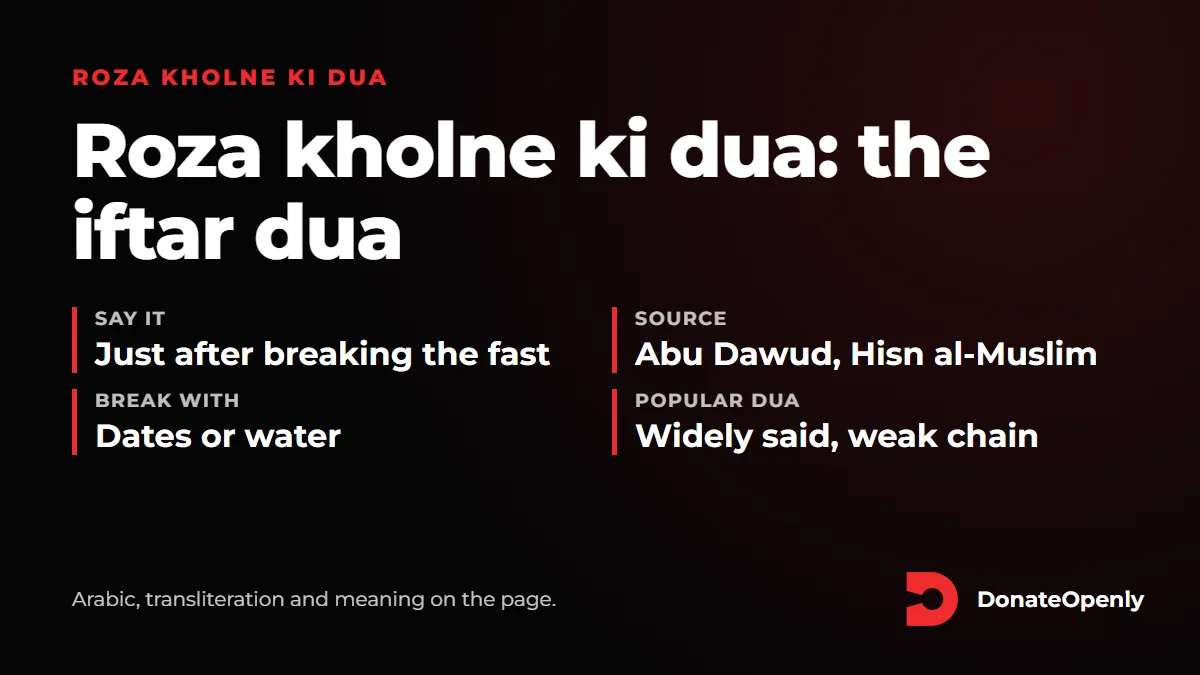
Roza kholne ki dua, the dua for breaking the fast, is “Dhahabaz-zama’u wabtallatil-‘uruqu wa thabatal-ajru in sha Allah”: “The thirst has gone, the veins are moistened, and the reward is confirmed, if Allah wills.” The Prophet ﷺ said it when he broke his fast, so it is said just after the first sip of water or date. Many people also say “Allahumma laka sumtu wa ‘ala rizqika aftartu” (O Allah, for You I fasted and with Your provision I break my fast). It is widely said, but its chain is weak. Both are explained below, with the iftar duas in Arabic, transliteration and English and what to do at sunset.
Roza kholne ki dua from the Sunnah
((ذَهَبَ الظَّمَأُ وَابْتَلَّتِ العُرُوقُ، وَثَبَتَ الْأَجْرُ إِنْ شَاءَ اللَّهُ)).
(Thahabath-thama-o wabtallatil-AAurooq, wathabatal-ajru in shaal-lah.)
(The thirst has gone and the veins are quenched, and reward is confirmed, if Allah wills.)
This is the dua the Prophet ﷺ said when he broke his fast. Abdullah ibn Umar reported it and Abu Dawud recorded it; many scholars accept its chain as sound (hasan). Of all the iftar duas, it has the strongest source.
Iftar dua meaning, word by word
- Dhahabaz-zama’u: the thirst has gone,
- wabtallatil-‘uruq: the veins are moistened,
- wa thabatal-ajru in sha Allah: and the reward is confirmed, if Allah wills.
Before or after breaking the fast?
The words describe thirst that has already gone, so scholars place this dua after you break the fast, not before. Say Bismillah, break your fast with a date or water, then say it.
Allahumma laka sumtu: the popular iftar dua
The iftar dua many of us learned as children is: Allahumma inni laka sumtu, wa bika amantu, wa ‘alayka tawakkaltu, wa ‘ala rizqika aftartu. It means: “O Allah, for You I fasted, in You I believe, in You I put my trust, and with Your provision I break my fast.”
Is it authentic?
Its short form, “Allahumma laka sumtu wa ‘ala rizqika aftartu”, is reported by Abu Dawud from Mu‘adh ibn Zuhrah, a Successor, without naming the Companion who heard it from the Prophet ﷺ. Hadith scholars therefore grade it weak. The middle phrases, “wa bika amantu wa ‘alayka tawakkaltu”, are not found in the hadith collections at all.
Can I still say it?
Its meaning is good, and many scholars say there is no harm in saying it as a general dua. If you want to keep to what is most firmly reported, say “Dhahabaz-zama’u” after breaking your fast. Many families say both.
Iftar se pehle ki dua: what to do at sunset
((إِذَا أَكَلَ أَحَدُكُمْ طَعَاماً فَلْيَقُلْ بِسْمِ اللَّهِ، فَإِنْ نَسِيَ فِي أَوَّلِهِ فَلْيَقُلْ بسمِ اللَّهِ فِي أَوَّلِهِ وَآخِرِهِ)).
(When you are about to eat, you should say:(Bismil-lah.)and if you forget to say it before starting, then you should say (when you remember):Bismil-lahi fee awwalihi wa-akhirih.)
(When you are about to eat, you should say:(Bismil-lah.)and if you forget to say it before starting, then you should say (when you remember):In the name of Allah in it’s beginning and end.)
Begin with Bismillah, the dua above, as at every meal. There is no fixed dua that must be said before iftar, but these are the steps the Sunnah teaches:
- Make dua while you wait: a hadith in at-Tirmidhi names the fasting person among those whose dua is not turned back. The minutes before sunset are a good time to ask.
- Break the fast straight away: the Prophet ﷺ said people will remain upon good as long as they hurry to break the fast (Sahih al-Bukhari and Sahih Muslim). Do not wait until after Maghrib prayer to begin.
- With dates or water: he broke his fast with fresh dates, or if there were none, dried dates, or if there were none, a few sips of water (reported by Abu Dawud and at-Tirmidhi).
- Then the dua: say Dhahabaz-zama’u, then pray Maghrib and eat your meal.
Check sunset for your city on the Ramadan timetable 2027.
Iftar ke baad ki dua and other duas at iftar
((اللَّهُمَّ إِنِّي أَسْأَلُكَ بِرَحْمَتِكَ الَّتِي وَسِعَتْ كُلَّ شَيْءٍ أَنْ تَغْفِرَ لِي)).
(Allahumma inne as-aluka birahmatikal-latee wasiAAat kulla shay, an taghfira lee.)
(O Allah, I ask You by Your mercy which envelopes all things, that You forgive me.)
((أَفْطَرَ عِنْدَكُمُ الصَّائِمُونَ، وَأَكَلَ طَعَامَكُمُ الْأَبْرَارُ، وَصَلَّتْ عَلَيْكُمُ الْمَلاَئِكَةُ)).
(Aftara AAindakumus-sa-imoon, wa-akala taAAamakumul-abrar, wasallat AAalaykumul-mala-ikah.)
(May the fasting break their fast in your home, and may the dutiful and pious eat your food, and may the angles send prayers upon you.)
The first dua above is one the Companion Abdullah ibn Amr used to say when he broke his fast: a short request for forgiveness by Allah’s mercy, which covers all things.
The second is what the Prophet ﷺ said to a family who gave him food when he was fasting (reported by Abu Dawud): may fasting people break their fast with you, may the righteous eat your food, and may the angels pray for you. Say it to whoever hosts your iftar.
Giving iftar
Whoever gives a fasting person iftar has a reward like his, without the fasting person’s reward being reduced at all (reported by at-Tirmidhi). Sharing dates and water at the masjid, feeding a neighbour, or helping provide iftar for families in Gaza all count.
Breaking fast dua in Ramadan and on other fasts
The roza kholne ki dua is the same for every fast: Ramadan, a fast you are making up, Mondays and Thursdays, the Day of Arafah, Ashura or the six days of Shawwal. See Ramadan 2027, the Day of Arafah 2027 and Ashura 2027 for the next dates.
Iftar dua in Bangla, Hindi and Urdu
Iftar er dua in Bangla, iftar ki dua in Urdu and Hindi, and roza iftar ki dua are all names for the same dua. The transliteration above can be read aloud by any speaker. Learn the Arabic, and know its meaning in your own language so your heart is in it.
Sehri and iftar duas together
For the start of the fast, the niyyah and the duas for the sehri meal, see roza rakhne ki dua.
Written for DonateOpenly from the sources it cites, and awaiting review by ulama. Dates are worked out from the Islamic calendar and depend on the moon sighting.
Choose a charity, then give on its own website
Every registered UK Muslim charity has a page on DonateOpenly: what it does, where its work reaches people and where donors review it.
Roza kholne ki dua (iftar dua): questions
What is roza kholne ki dua?
It is “Dhahabaz-zama’u wabtallatil-‘uruqu wa thabatal-ajru in sha Allah”: the thirst has gone, the veins are moistened, and the reward is confirmed, if Allah wills. The Prophet ﷺ said it when he broke his fast (Abu Dawud).
Is the iftar dua said before or after breaking the fast?
Say Bismillah, break your fast, then say “Dhahabaz-zama’u”, because its words describe the thirst that has just gone. The minutes before sunset are a good time for your own duas.
Is “Allahumma laka sumtu” authentic?
Its short form is reported by Abu Dawud with a broken chain, so hadith scholars grade it weak, and the extra phrases “wa bika amantu wa ‘alayka tawakkaltu” are not in the hadith books. Its meaning is good and many say it as a general dua.
What is the iftar dua in English?
“The thirst has gone, the veins are moistened, and the reward is confirmed, if Allah wills.” The popular dua means “O Allah, for You I fasted and with Your provision I break my fast.”
What should I break my fast with?
The Prophet ﷺ broke his fast with fresh dates, or dried dates, or if there were none, a few sips of water (Abu Dawud and at-Tirmidhi).
Is the dua for breaking fast the same outside Ramadan?
Yes. The same dua is said at the end of any fast: a voluntary fast, a make-up fast, Arafah or Ashura.