- Home
- Namaz ki niyat
Salah
Namaz ki Niyat: How to Make the Intention for Each Prayer (Fajr, Zuhr, Asr, Maghrib, Isha, Witr, Eid, Qaza)
The intention is in the heart: what it must include, whether to say it aloud, and sample wordings for each prayer
Namaz ki niyat is the intention for the prayer, and it is made in the heart: knowing which prayer you are about to pray, and that you pray it for Allah. All four schools agree the heart’s intention is what counts. Saying the niyat aloud is not required; many later scholars thought saying it quietly helps the heart focus, while others held it is not from the sunnah. Below is what the niyat must include, and simple wordings in English and Urdu for the fard, sunnah, witr, Eid and qaza prayers.
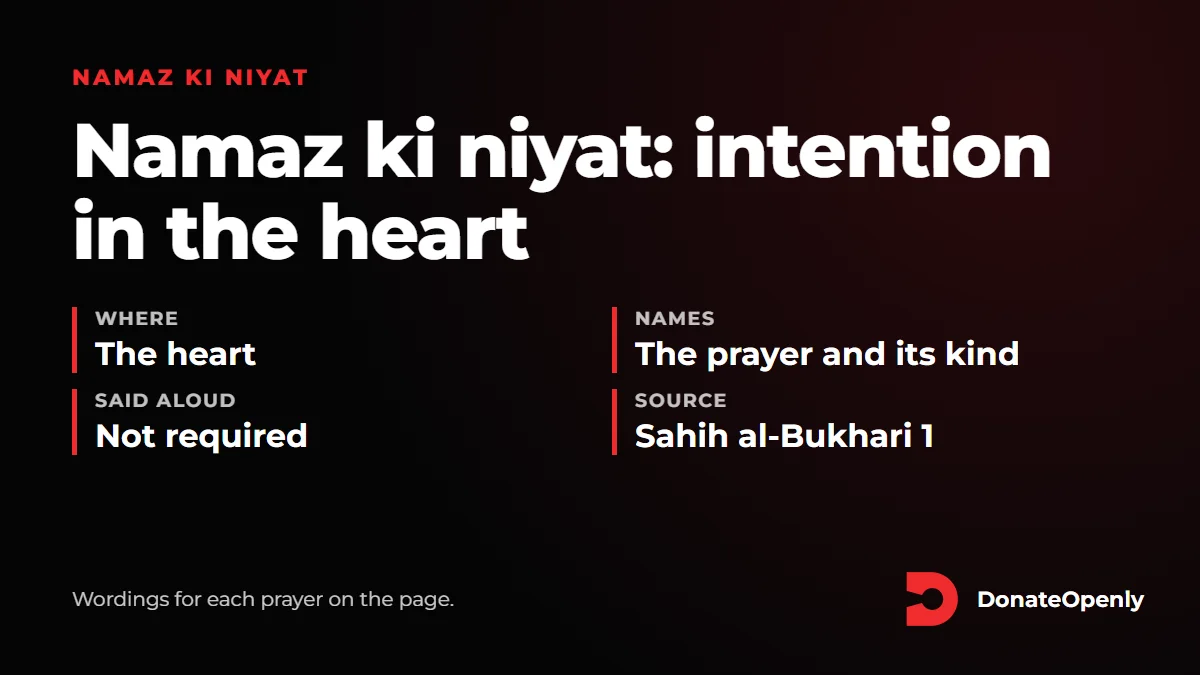
Namaz ki niyat: what it means
Niyat (niyyah) means intention. The Prophet (peace be upon him) said: actions are only by intentions, and every person will have what he intended (Sahih al-Bukhari 1).
- Where: in the heart, at the moment of the opening takbir or just before it.
- What it names: the prayer (Fajr, Zuhr…), whether it is fard, wajib, sunnah or nafl, and for a follower, that you pray behind the imam.
- What it does not need: the number of rakats or the direction said in words. Knowing them is enough.
Is saying the niyat aloud necessary?
No. The schools agree that the intention of the heart is the condition. Many later scholars of the Hanafi, Shafi’i and Hanbali schools considered saying it quietly recommended, to help the heart; other scholars, including many Malikis, said it is better left, as it is not reported from the Prophet. Neither view makes the prayer invalid.
Niyat for the five daily prayers
If you like to put it into words, these simple forms are enough. Change the prayer’s name and rakats as needed.
- English: “I intend to pray two rakats fard of Fajr for Allah, facing the qibla.”
- Urdu (transliterated): “Niyat karta hoon do rakat namaz farz Fajr ki, waste Allah Ta‘ala ke, munh mera taraf Ka‘ba Sharif ke, Allahu akbar.” A woman says “karti hoon”.
- Behind the imam, add: “peeche is imam ke” (behind this imam).
Fard rakats for each niyat
- Fajr: do rakat farz.
- Zuhr: char rakat farz.
- Asr: char rakat farz.
- Maghrib: teen rakat farz.
- Isha: char rakat farz.
For sunnah, say “sunnat Rasulullah” in place of farz; for nafl, “nafl”.
Niyat for witr, Eid, Jummah and janazah
- Witr: “Niyat karta hoon teen rakat namaz witr wajib, waste Allah Ta‘ala ke…” See witr namaz.
- Eid: “…do rakat namaz Eid ul Fitr (or Eid ul Adha) wajib, cheh zaid takbiron ke saath, peeche is imam ke.” See Eid ki namaz ka tarika.
- Jummah: “…do rakat namaz farz Jumu‘ah, peeche is imam ke.” See jumma namaz rakats.
- Janazah: “…namaz e janaza, char takbiron ke saath, waste Allah Ta‘ala ke, dua is mayyit ke liye, peeche is imam ke.” See namaz e janaza.
- Taraweeh, tahajjud and other nafl: two rakats of that prayer, for Allah.
Qaza namaz ki niyat
When making up a missed prayer, the intention must name which prayer it replaces.
- If you know the day: “I intend to pray the four rakats fard of Zuhr that I missed on Monday.”
- If you have many missed prayers: the Hanafi scholars teach naming the first (or last) of them still owed: “…the first Fajr I owe that I have not made up.” Repeat that wording each time, and the list shortens from one end.
See qaza namaz for the order of make-up prayers and the views of the schools.
Written for DonateOpenly from the sources it cites, and awaiting review by ulama. Dates are worked out from the Islamic calendar and depend on the moon sighting.
Choose a charity, then give on its own website
Every registered UK Muslim charity has a page on DonateOpenly: what it does, where its work reaches people and where donors review it.
Namaz ki niyat: questions
What is the niyat of namaz?
The intention in the heart to pray a particular prayer for Allah. You may put it into words, but the heart’s intention is what counts.
Is it necessary to say the niyat out loud?
No. All schools agree the intention is in the heart. Some scholars recommend saying it quietly to help focus; others say it is not from the sunnah.
What is the niyat for Fajr namaz?
To pray two rakats fard of Fajr for Allah. Before it, the intention for the two sunnah of Fajr.
Does the niyat have to be in Arabic?
No. The intention is in the heart and needs no language. If you say it, any language is fine.
What is the hadith about intentions?
“Actions are only by intentions, and every person will have only what he intended” (Sahih al-Bukhari 1).