- Home
- 40 hadith of an-Nawawi
Hadith
40 Hadith of Imam an-Nawawi: The Forty Hadith Collection, Its Themes and How to Learn It
Forty-two short hadith that hold the foundations of Islam, gathered by Imam an-Nawawi
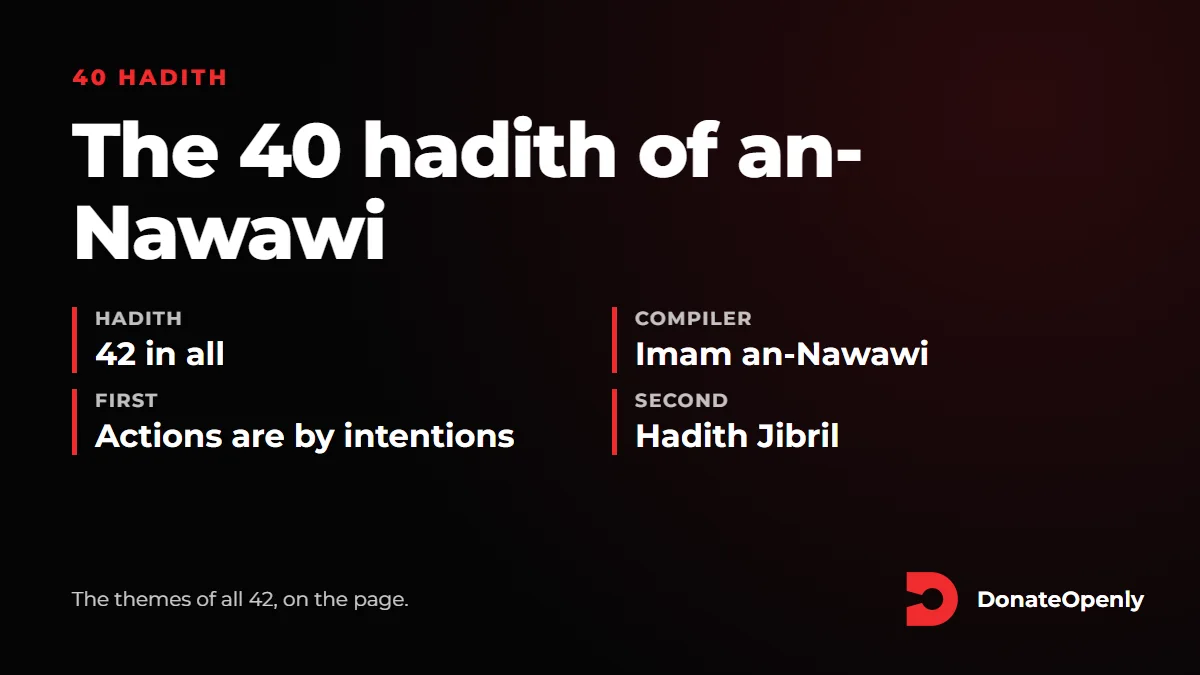
The 40 hadith (al-Arba‘in an-Nawawiyyah) is a small collection by Imam Yahya ibn Sharaf an-Nawawi (631–676 AH), chosen because each hadith is a foundation of the religion. Despite the name it has 42 hadith. It opens with “actions are only by intentions” and covers faith, worship, halal and haram, character, and the heart. It is often the first hadith book Muslims study and memorise. This page describes the collection, its themes in order, its commentaries and how to learn it.
What is the 40 hadith collection?
مَّآ أَفَآءَ ٱللَّهُ عَلَىٰ رَسُولِهِۦ مِنۡ أَهۡلِ ٱلۡقُرَىٰ فَلِلَّهِ وَلِلرَّسُولِ وَلِذِي ٱلۡقُرۡبَىٰ وَٱلۡيَتَٰمَىٰ وَٱلۡمَسَٰكِينِ وَٱبۡنِ ٱلسَّبِيلِ كَيۡ لَا يَكُونَ دُولَةَۢ بَيۡنَ ٱلۡأَغۡنِيَآءِ مِنكُمۡۚ وَمَآ ءَاتَىٰكُمُ ٱلرَّسُولُ فَخُذُوهُ وَمَا نَهَىٰكُمۡ عَنۡهُ فَٱنتَهُواْۚ وَٱتَّقُواْ ٱللَّهَۖ إِنَّ ٱللَّهَ شَدِيدُ ٱلۡعِقَابِ ٧
mā afāa l-lahu ʿalā rasūlihi min ahli l-qurā falillahi walilrrasūli walidhī l-qur'bā wal-yatāmā wal-masākīni wa-ib'ni l-sabīli kay lā yakūna dūlatan bayna l-aghniyāi minkum wamā ātākumu l-rasūlu fakhudhūhu wamā nahākum ʿanhu fa-intahū wa-ittaqū l-laha inna l-laha shadīdu l-ʿiqābi
And what Allāh restored to His Messenger from the people of the towns - it is for Allāh and for the Messenger and for [his] near relatives and orphans and the needy and the [stranded] traveler - so that it will not be a perpetual distribution among the rich from among you. And whatever the Messenger has given you - take; and what he has forbidden you - refrain from. And fear Allāh; indeed, Allāh is severe in penalty.
Many scholars before an-Nawawi had gathered sets of forty hadith. In his introduction an-Nawawi explains that he chose forty that are each a great principle of the religion, mostly from Sahih al-Bukhari and Sahih Muslim, kept short so they are easy to memorise, and he added two more, making 42.
- Compiler: Imam an-Nawawi of Damascus, also author of Riyad as-Salihin, al-Adhkar and the commentary on Sahih Muslim.
- Length: 42 hadith, each a few lines.
- Sources: most are from al-Bukhari and Muslim; the rest from at-Tirmidhi, Abu Dawud, Ibn Majah and others, with their gradings noted by scholars.
Why forty?
An-Nawawi notes in his introduction that the narration promising a reward for preserving forty hadith is weak by the agreement of hadith scholars, and that he relied instead on the authentic hadith urging those present to convey what they hear to those absent.
The themes of the 40 hadith
- Hadith 1: actions are judged by intentions.
- Hadith 2: hadith Jibril, on Islam, iman, ihsan and the Hour. See hadith Jibril.
- Hadith 3: Islam is built on five. See 5 pillars of Islam.
- Hadith 4: the creation of a person in the womb and the decree.
- Hadith 5 to 6: rejecting innovation in religion; the halal is clear and the haram is clear.
- Hadith 7: the religion is sincerity (naseehah).
- Hadith 9 to 14: doing what you can of what is commanded, Allah accepts only what is good, leaving what makes you doubt, leaving what does not concern you, loving for your brother what you love for yourself, and the sanctity of life.
- Hadith 15 to 18: speak good or stay silent, do not be angry, do everything with excellence, fear Allah wherever you are and follow a bad deed with a good one.
- Hadith 19: be mindful of Allah and He will protect you.
- Hadith 23 to 26: purity is half of faith, Allah has forbidden injustice for Himself, every good deed is charity, and every joint owes a charity each day.
- Hadith 32: there should be neither harm nor returning harm.
- Hadith 34 to 36: changing wrong by hand, tongue or heart; brotherhood without envy; relieving a believer’s hardship.
- Hadith 40: be in this world as a stranger or a traveller.
- Hadith 42: Allah’s promise to forgive the one who calls on Him and hopes in Him.
Several are hadith qudsi, in which the Prophet ﷺ relays words from Allah.
Commentaries on the 40 hadith
- An-Nawawi’s own short explanation of his collection.
- Ibn Daqiq al-‘Id: a concise classical commentary.
- Ibn Rajab al-Hanbali, Jami‘ al-‘Ulum wal-Hikam: the best-known commentary. Ibn Rajab added eight hadith to make fifty.
Many modern commentaries exist in English, Urdu, Arabic and other languages, in print and as recorded classes.
How to learn the 40 hadith of an-Nawawi
- One a week: learn the meaning of one hadith a week and you will finish in under a year.
- Meaning first: read a translation and a short commentary before memorising the Arabic.
- Memorise with a family member or friend: test each other at meals or on the way to the masjid.
- Act on one thing: each hadith has a lesson to live. Choose one and practise it that week.
Forty hadith for children
Many teachers start children with the shortest ones: “do not be angry”, “speak good or stay silent” and “the religion is sincerity”.
Written for DonateOpenly from the sources it cites, and awaiting review by ulama. Dates are worked out from the Islamic calendar and depend on the moon sighting.
Choose a charity, then give on its own website
Every registered UK Muslim charity has a page on DonateOpenly: what it does, where its work reaches people and where donors review it.
40 hadith of an-Nawawi: questions
What is the 40 hadith of an-Nawawi?
A collection of 42 short, foundational hadith gathered by Imam an-Nawawi (631–676 AH), widely studied and memorised.
Why are there 42 hadith in the 40 hadith?
An-Nawawi chose forty and added two more. The name stayed as “the Forty”, a common title for such collections.
What is the first hadith of the 40 hadith?
“Actions are only by intentions”, narrated by Umar ibn al-Khattab, reported by al-Bukhari and Muslim.
Are all the 40 hadith sahih?
Most are from Sahih al-Bukhari and Sahih Muslim. A few are from other collections, and scholars have discussed the grading of some of those.
How long does it take to memorise the 40 hadith?
At one hadith a week, under a year. Many learn them faster; what matters is understanding and acting on them.