- Home
- Zikr after namaz
Dhikr
Zikr After Namaz: The Tasbeeh After Salah (33, 33, 34), Ayat al-Kursi and the Adhkar After Prayer
The counted remembrance after every fard prayer: what to say, how many times, and the reward the Prophet promised
The zikr after namaz is: Subhanallah 33 times, Alhamdulillah 33 times, Allahu akbar 33 times, and then “La ilaha illallahu wahdahu la sharika lah, lahul-mulku wa lahul-hamd, wa huwa ‘ala kulli shay’in qadir” once to make a hundred. The Prophet (peace be upon him) said whoever says this after every prayer has his sins forgiven even if they are like the foam of the sea (Sahih Muslim). With it come Ayat al-Kursi and the last three surahs. Here are the adhkar after salah with their counts.
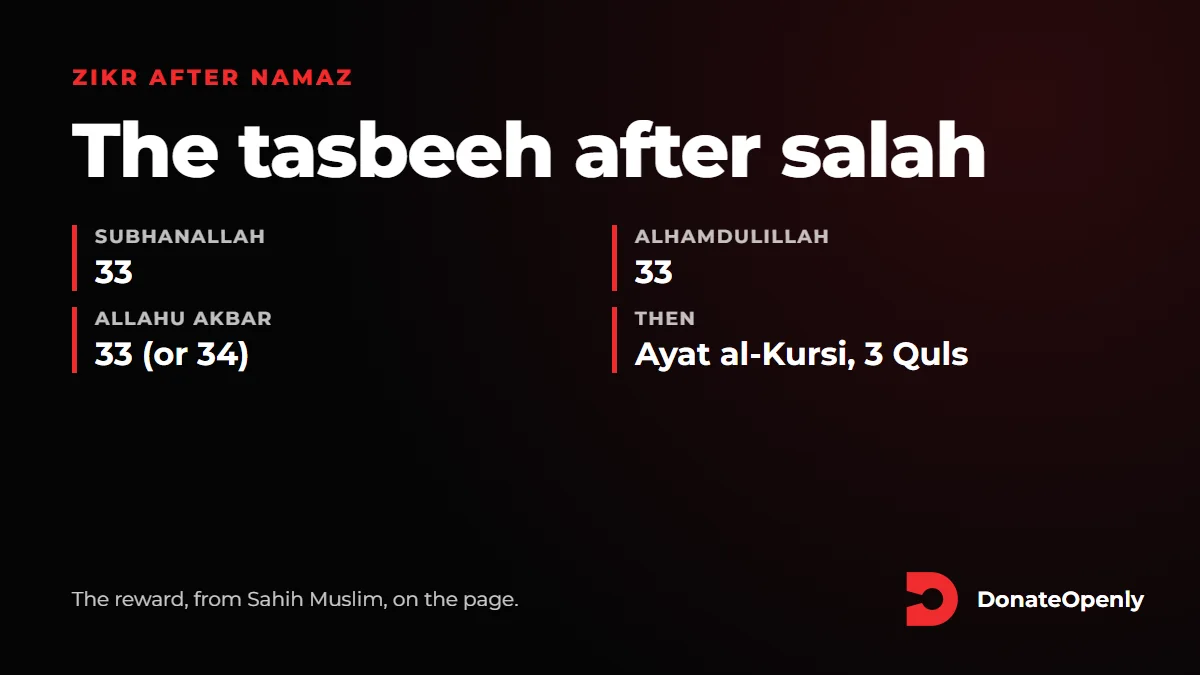
Tasbeeh after salah: 33, 33, 33 and 1
((سُبْحَانَ اللَّهِ، وَالْحَمْدُ لِلَّهِ، وَاللَّهُ أَكْبَرُ (ثلاثاً وثلاثين) لاَ إِلَهَ إِلاَّ اللَّهُ وَحْدَهُ لاَ شَرِيكَ لَهُ، لَهُ الْمُلْكُ وَلَهُ الْحَمْدُ وَهُوَ عَلَى كُلِّ شَيْءٍ قَدِيرٌ)).
(Subhanal-lah walhamdu lillah, wallahu akbar (thirty-three times). (La ilaha illal-lahu wahdahu la shareeka lah, lahul-mulku walahul-hamd, wahuwa AAala kulli shayin qadeer.))
(How perfect Allah is, all praise is for Allah, and Allah is the greatest.(thirty-three times) (None has the right to be worshipped except Allah, alone, without partner, to Him belongs all sovereignty and praise and He is over all things omnipotent.))
- Subhanallah (How perfect is Allah): 33 times.
- Alhamdulillah (All praise is for Allah): 33 times.
- Allahu akbar (Allah is the Greatest): 33 times.
- La ilaha illallahu wahdahu la sharika lah, lahul-mulku wa lahul-hamd, wa huwa ‘ala kulli shay’in qadir: once, to make a hundred.
Other counts that are reported
Another sound report has Allahu akbar 34 times in place of the tahlil, making 100 (Sahih Muslim); this is also the count of the tasbih of Fatimah before sleeping. Another has each of the first three 25 times with the tahlil 25 times. Any of these is sunnah.
Ayat al-Kursi and the 3 Quls after every prayer
﴿اللَّهُ لاَ إِلَهَ إِلاَّ هُوَ الْحَيُّ الْقَيُّومُ لاَ تَأْخُذُهُ سِنَةٌ وَلاَ نَوْمٌ لَّهُ مَا فِي السَّمَوَاتِ وَمَا فِي الأَرْضِ مَن ذَا الَّذِي يَشْفَعُ عِنْدَهُ إِلاَّ بِإِذْنِهِ يَعْلَمُ مَا بَيْنَ أَيْدِيهِمْ وَمَا خَلْفَهُمْ وَلاَ يُحِيطُونَ بِشَيْءٍ مِّنْ عِلْمِهِ إِلاَّ بِمَا شَاءَ وَسِعَ كُرْسِيُّهُ السَّمَوَاتِ وَالأَرْضَ وَلاَ يَؤُودُهُ حِفْظُهُمَا وَهُوَ الْعَلِيُّ الْعَظِيمُ﴾ عَقِبَ كلِّ صَلاَةٍ.
It is also from the Sunnah to recite Aayat ul-Kursee after each prayer:[Soorah al-Baqarah, Aayah 255]
بسم الله الرحمن الرحيم ﴿قُلْ هُوَ اللَّهُ أَحَدٌ* اللَّهُ الصَّمَدُ* لَمْ يَلِدْ وَلَمْ يُولَدْ* وَلَمْ يَكُن لَّهُ كُفُواً أَحَدٌ﴾، بسم الله الرحمن الرحيم ﴿قُلْ أَعُوذُ بِرَبِّ الْفَلَقِ* مِن شَرِّ مَا خَلَقَ* وَمِن شَرِّ غَاسِقٍ إِذَا وَقَبَ* وَمِن شَرِّ النَّفَّاثَاتِ فِي الْعُقَدِ* وَمِن شَرِّ حَاسِدٍ إِذَا حَسَدَ﴾،بسم الله الرحمن الرحيم ﴿قُلْ أَعُوذُ بِرَبِّ النَّاسِ* مَلِكِ النَّاسِ* إِلَهِ النَّاسِ* مِن شَرِّ الْوَسْوَاسِ الْخَنَّاسِ* الَّذِي يُوَسْوِسُ فِي صُدُورِ النَّاسِ* مِنَ الْجِنَّةِ وَ النَّاسِ﴾ بَعْدَ كُلِّ صَلاَةٍ.
The following three Soorahs should be recited once after Zuhr, 'Asr and 'Ishaa prayers and thrice after the Fajr and Maghrib prayers.[Soorah al-Ikhlaas (112)] [Soorah al-Falaq (113)] [Soorah an-Naas (114)]
- Ayat al-Kursi: after every fard prayer. The Prophet said nothing prevents the one who recites it after each prayer from entering Paradise except death (reported by an-Nasa’i). See Ayatul Kursi.
- Al-Ikhlas, Al-Falaq and An-Nas: once after Zuhr, Asr and Isha, three times after Fajr and Maghrib. See the 4 Qul.
Adhkar after salah: the full order
- 1: Astaghfirullah three times, then Allahumma antas-salam (see dua after salah).
- 2: the tahlil said after the fard prayers.
- 3: the tasbih: 33, 33, 33 and the tahlil.
- 4: Ayat al-Kursi.
- 5: Al-Ikhlas, Al-Falaq, An-Nas.
- 6: after Fajr and Maghrib, the tahlil ten times; after Fajr, the dua for beneficial knowledge.
- 7: your own dua.
If the Hanafi practice of your mosque is to pray the sunnah soon after the fard, many say the short dua of step 1, pray the sunnah, then complete the tasbih.
How to count the zikr after namaz
Abdullah ibn Amr said he saw the Prophet count the tasbih on his right hand (Sunan Abi Dawud and Jami‘ at-Tirmidhi, in Hisn al-Muslim). Counting on the fingers is the sunnah; the fingers will testify on the Day of Judgement, as he said. Many scholars allow beads or a counter as well.
Why it matters
The poor Companions complained that the rich prayed and fasted as they did but also gave charity. The Prophet taught them this tasbih after every prayer, saying no one would surpass them except one who did the same (Sahih al-Bukhari and Sahih Muslim). See also Subhanallah meaning.
Written for DonateOpenly from the sources it cites, and awaiting review by ulama. Dates are worked out from the Islamic calendar and depend on the moon sighting.
Choose a charity, then give on its own website
Every registered UK Muslim charity has a page on DonateOpenly: what it does, where its work reaches people and where donors review it.
Zikr after namaz: questions
What is the zikr after namaz?
Subhanallah 33, Alhamdulillah 33, Allahu akbar 33, then “La ilaha illallahu wahdahu la sharika lah…” once; with Ayat al-Kursi and the three Quls.
What is the reward of the tasbeeh after salah?
The Prophet said whoever says it after every prayer has his sins forgiven even if they are like the foam of the sea (Sahih Muslim).
Is it 33 or 34 times Allahu akbar?
Both are sunnah: 33 with the tahlil to make 100, or 34 alone to make 100.
Can I do the zikr after namaz on tasbih beads?
The sunnah is counting on the right hand’s fingers. Many scholars allow beads or a counter.
Should I read Ayat al-Kursi after every namaz?
Yes, after every fard prayer. It is in Hisn al-Muslim among the remembrances after the prayer.