- Home
- Talbiyah
Hajj and Umrah
Talbiyah: Labbaik Allahumma Labbaik, the Pilgrim’s Call for Hajj and Umrah
The words every pilgrim says from ihram: their meaning, when to say them, and when to stop
The talbiyah is the call of the pilgrim on Hajj and Umrah: “Labbayk Allahumma labbayk, labbayka la sharika laka labbayk, innal-hamda wan-ni‘mata laka wal-mulk, la sharika lak.” It means “Here I am, O Allah, here I am. Here I am, You have no partner, here I am. All praise, all blessings and all sovereignty are Yours. You have no partner.” It is the talbiyah of the Prophet ﷺ (Sahih al-Bukhari 1549), said from the moment you enter ihram.
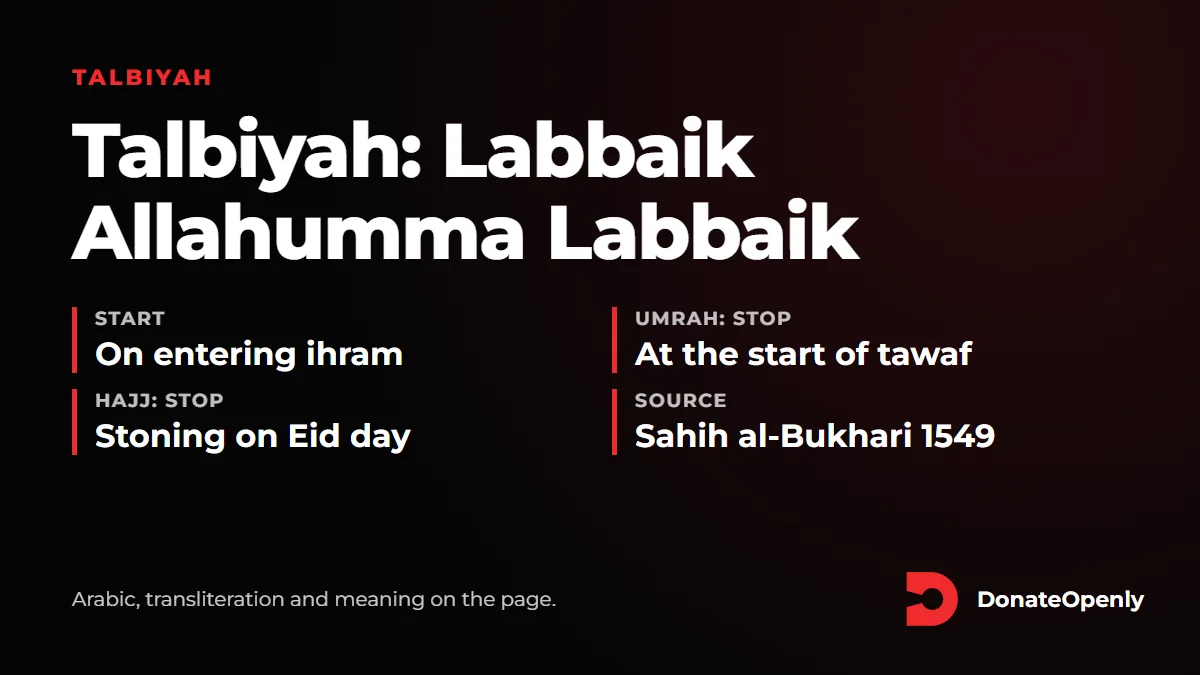
The talbiyah in transliteration and English
((لَبَّيْكَ اللَّهُمَّ لَبَّيْكَ، لَبَّيْكَ لاَ شَرِيكَ لَكَ لَبَّيْكَ، إِنَّ الْحَمْدَ، وَالنِّعْمَةَ، لَكَ وَالْمُلْكَ، لاَ شَرِيكَ لَكَ)).
(Labbaykal-lahumma labbayk, labbayka la shareeka laka labbayk, innal-hamda wanniAAmata laka walmulk, la shareeka lak.)
(Here I am O Allah, (in response to Your call), here I am. Here I am, You have no partner, here I am. Verily all praise, grace and sovereignty belong to You. You have no partner.)
These are the words of the talbiyah as Hisn al-Muslim gives them, with the Arabic, transliteration and English.
Talbiyah word by word
- Labbayk: here I am, answering Your call, again and again.
- Allahumma: O Allah.
- la sharika lak: You have no partner.
- innal-hamda: all praise,
- wan-ni‘mata: and every blessing,
- laka wal-mulk: are Yours, and all sovereignty.
The talbiyah is an answer: the pilgrim is replying to the call of Ibrahim, whom Allah commanded to proclaim the Hajj to mankind.
Talbiyah for Umrah and Hajj: when to say it
وَأَذِّن فِي ٱلنَّاسِ بِٱلۡحَجِّ يَأۡتُوكَ رِجَالٗا وَعَلَىٰ كُلِّ ضَامِرٖ يَأۡتِينَ مِن كُلِّ فَجٍّ عَمِيقٖ ٢٧
wa-adhin fī l-nāsi bil-ḥaji yatūka rijālan waʿalā kulli ḍāmirin yatīna min kulli fajjin ʿamīqin
And proclaim to the people the ḥajj [pilgrimage]; they will come to you on foot and on every lean camel; they will come from every distant pass -
- Start: as soon as you make the intention and enter ihram, at or before the miqat. See ihram meaning.
- Keep saying it: on the road, getting on and off transport, going up and down, meeting other pilgrims, after prayers.
- Umrah: stop when you begin the tawaf of Umrah, at the Black Stone. See umrah guide.
- Hajj: stop when you begin stoning Jamrat al-‘Aqabah on the day of Eid, 10 Dhul Hijjah. See Hajj steps.
Talbiyah haji: for the pilgrim of Hajj
The talbiyah of Hajj and of Umrah is the same. A pilgrim doing Tamattu‘ says it from the miqat until the Umrah tawaf, stops, then begins it again on 8 Dhul Hijjah when entering ihram for Hajj.
How to say the talbiyah
- Men: aloud. The Prophet ﷺ said Jibril told him to command his Companions to raise their voices with the talbiyah (reported by Abu Dawud, at-Tirmidhi and others).
- Women: quietly, so that those beside them hear.
- Each on their own: not in chorus led by a group leader; scholars note the Companions each said it themselves.
- Adding words: Companions such as Ibn Umar added praise like “labbayka wa sa‘dayk”; keeping to the Prophet’s ﷺ wording is best.
Is the talbiyah obligatory?
Scholars differ. For the Hanafi school, the talbiyah, or an equivalent dhikr, said with the intention is what enters you into ihram; for the Shafi‘i and Hanbali schools it is a sunnah; the Maliki school makes it necessary, with a sacrifice for leaving it. Whatever your school, say it.
The meaning behind the talbiyah
Each line is tawhid: the pilgrim declares that all praise, all blessing and all power belong to Allah alone, without partner. Before Islam, the idolaters of Makkah added the names of their idols to their talbiyah; the Prophet ﷺ restored it to pure worship of Allah.
Saying it in crowds of millions, in many accents, is one of the most moving moments of a pilgrim’s life. For the other duas of the journey, see Hajj dua and tawaf ki dua.
Written for DonateOpenly from the sources it cites, and awaiting review by ulama. Dates are worked out from the Islamic calendar and depend on the moon sighting.
Choose a charity, then give on its own website
Every registered UK Muslim charity has a page on DonateOpenly: what it does, where its work reaches people and where donors review it.
Talbiyah: questions
What is the talbiyah?
The pilgrim’s call: “Labbayk Allahumma labbayk, labbayka la sharika laka labbayk, innal-hamda wan-ni‘mata laka wal-mulk, la sharika lak” (Sahih al-Bukhari 1549).
What does Labbaik Allahumma Labbaik mean?
“Here I am, O Allah, here I am”: the pilgrim answering Allah’s call to His House.
When do I stop the talbiyah in Umrah?
When you begin the tawaf of Umrah, at the Black Stone.
When do I stop the talbiyah in Hajj?
When you begin stoning Jamrat al-‘Aqabah on 10 Dhul Hijjah, the day of Eid.
Do women say the talbiyah aloud?
Women say it quietly, so that those next to them can hear; men raise their voices.