- Home
- Learn Arabic
Learn Arabic
Learn Arabic: the Best Way to Learn Arabic for Beginners, Step by Step
A clear path from the letters to understanding: which Arabic to learn, the order of study, online classes and free ways to start
The best way to learn Arabic is in a clear order: the alphabet and reading first, then everyday and Quranic vocabulary, then the basic grammar that ties words together, with a little practice every day and a teacher to correct you. Most Muslims learn Arabic to understand the Quran and their prayers, and that goal shapes which Arabic to learn. Here is the step-by-step path, the kinds of Arabic, how to choose a course or tutor, and free ways to begin today.
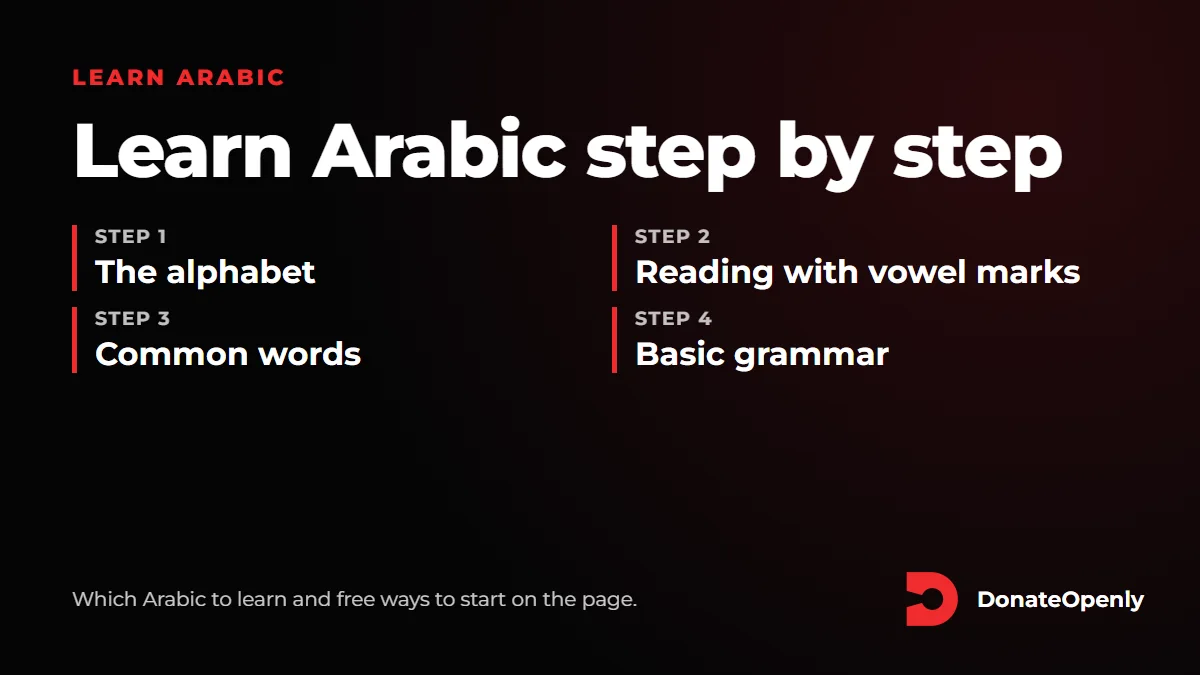
How to learn Arabic, step by step
- 1. The alphabet: the 28 letters, their sounds and forms. See the Arabic alphabet. Allow a few weeks.
- 2. Reading with the vowel marks: a qaida or primer until you can read any word slowly. See Arabic reading.
- 3. Core vocabulary: the commonest words of daily life and the Quran. Start with 100 basic words in Arabic.
- 4. Basic grammar: nouns, verbs and particles; how “the” works; masculine and feminine; the past and present verb.
- 5. Roots and patterns: most Arabic words grow from three-letter roots. Once you see the patterns, new words become easy to guess.
- 6. Read, listen and speak: short texts, the Quran with its meaning, and conversation with a teacher or partner.
Arabic for beginners: how long does it take?
Reading takes a few months. Understanding simple texts and much of the Quran’s common language takes one to three years of steady study. Speaking fluently takes longer, and depends on how much you practise.
Which Arabic should you learn?
- Classical or Quranic Arabic: the language of the Quran, the hadith and the scholars. The best choice if your aim is to understand the Quran and your prayers. See learn Quranic Arabic.
- Modern Standard Arabic (MSA): the modern form of the same language, used in news, books and formal speech across the Arab world. Its grammar is almost the same as the Quran’s; its vocabulary is modern.
- Spoken dialects: Egyptian, Levantine, Gulf, Iraqi and the Maghrebi dialects, such as Moroccan darija. Each country speaks its own, and they differ a good deal from one another.
Learning to speak Arabic
If you will live, work or marry into an Arabic-speaking family, add the local dialect once you have a base in standard Arabic. Conversation practice, even ten minutes a day with a tutor, is what turns knowledge into speech.
Learn Arabic online or in a class
There are good options for every budget:
- One-to-one tutor: fastest progress, because every minute is yours. Ideal for speaking and for Quran reading.
- Group classes: at a mosque, college or online. Cheaper, steady, and good for motivation.
- Self-paced courses and apps: useful for vocabulary and revision, but they cannot hear and correct you.
- Full-time study: some universities and institutes in the UK and abroad offer intensive Arabic programmes.
How to choose an Arabic course or tutor
- A clear syllabus: you should know what you will learn each month.
- Speaking from the start: you should speak and read aloud in every lesson.
- A trial lesson: check that the teacher corrects you clearly and kindly.
- For children: keep online lessons visible, stay nearby, and choose teachers who are open about their training.
Learn Arabic for free
You can make real progress before paying for anything:
- Mosque classes: many mosques run free or low-cost Arabic and Quran classes.
- Free textbooks: the Madinah Arabic books, written for students at the Islamic University of Madinah, are widely shared and used around the world.
- The Quran itself: the surah pages here show the meaning of every word; read a few verses a day and note new words.
- Libraries and community groups: look for Arabic conversation circles near you.
Make it easy on yourself
Arabic is easier than its reputation. The script is regular, spelling follows sound, and roots make vocabulary hang together. The hard part is consistency: fifteen minutes a day beats three hours once a week.
Why Muslims learn Arabic
إِنَّآ أَنزَلۡنَٰهُ قُرۡءَٰنًا عَرَبِيّٗا لَّعَلَّكُمۡ تَعۡقِلُونَ ٢
innā anzalnāhu qur'ānan ʿarabiyyan laʿallakum taʿqilūna
Indeed, We have sent it down as an Arabic Qur’ān that you might understand.
Allah sent the Quran in Arabic so that it would be understood. Every Muslim says Arabic in every prayer; learning it turns the words of salah from sounds into conversation with Allah.
Start with what you already say
Begin with the meaning of Surah Al-Fatiha and the words of your salah. You say them at least seventeen times a day, so they are the fastest Arabic you will ever learn.
Written for DonateOpenly from the sources it cites, and awaiting review by ulama. Dates are worked out from the Islamic calendar and depend on the moon sighting.
Choose a charity, then give on its own website
Every registered UK Muslim charity has a page on DonateOpenly: what it does, where its work reaches people and where donors review it.
Learn Arabic: questions
What is the best way to learn Arabic?
Learn the alphabet and reading first, then common vocabulary and basic grammar, with daily practice and a teacher who corrects you. Little and often works best.
Is Arabic hard to learn?
Arabic takes effort, but its script is regular and its words grow from roots in clear patterns. With steady daily study, beginners read within months.
Can I learn Arabic online?
Yes. Live one-to-one or small group classes online work very well, especially with a teacher who has you speak and read aloud in every lesson.
Should I learn Modern Standard Arabic or Quranic Arabic?
If your main aim is the Quran and prayer, learn Quranic (classical) Arabic. If you need to read news or work in the Arab world, learn MSA. The two share almost all their grammar.
Can I learn Arabic for free?
Yes. Free mosque classes, the widely shared Madinah Arabic books and word-by-word Quran pages are enough to get you reading and understanding the basics.