- Home
- Khatam Quran dua
The Quran
Khatam Quran Dua: The Dua After Finishing the Quran and After Reading the Quran
What the Sunnah and the early Muslims did when they completed the Quran, the well-known printed dua, and duas to say after reading
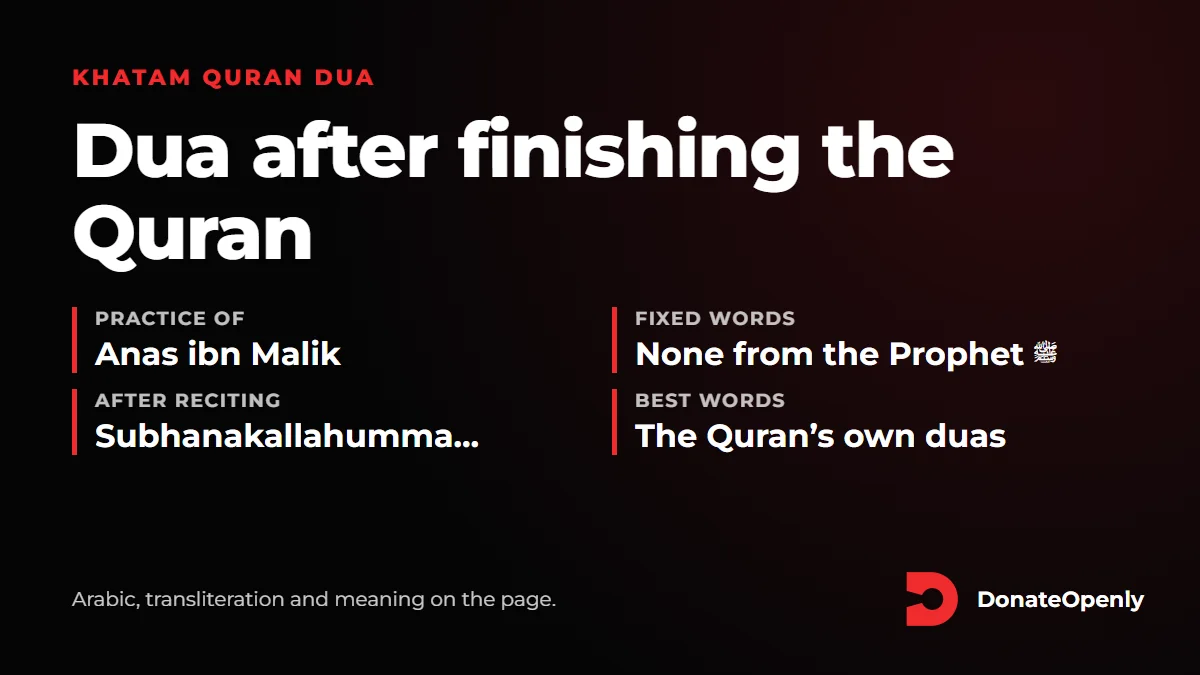
There is no single khatam Quran dua fixed by the Prophet ﷺ, but making dua when you finish the Quran is a well-established practice of the early Muslims: Anas ibn Malik would gather his family when he completed the Quran and make dua for them. You can ask Allah for anything at a khatam, in any words, and the Quran’s own duas are the best to use. The long dua printed at the end of many mushafs, beginning “Allahummarhamni bil-Qur’an”, is widely recited; it is not authentically traced to the Prophet ﷺ, though its meaning is good. This page explains what is reported, gives duas to say after reading the Quran, and how families mark a khatam.
What is reported about the khatam Quran dua
- Anas ibn Malik: when he completed the Quran, he gathered his family and children and made dua for them. This is reported in the Sunan of ad-Darimi and other early books, and scholars such as an-Nawawi cite it.
- The early Muslims: several of the generation after the companions said that mercy descends at the completion of the Quran and that dua is hoped to be answered then. These are their words, not a hadith of the Prophet ﷺ.
- No fixed words: no particular khatam dua is authentically reported from the Prophet ﷺ. Choose the duas that matter to you.
The printed dua at the end of the mushaf
Many mushafs end with a long dua beginning “Allahummarhamni bil-Qur’an, waj‘alhu li imaman wa nuran wa hudan wa rahmah”: O Allah, have mercy on me through the Quran, and make it for me a leader, a light, a guidance and a mercy. Hadith scholars found no sound chain for it to the Prophet ﷺ. Its meaning is good, so there is no harm in saying it as your own dua, without believing it is a sunnah.
Quran duas to say at a khatam
وَإِذۡ يَرۡفَعُ إِبۡرَٰهِـۧمُ ٱلۡقَوَاعِدَ مِنَ ٱلۡبَيۡتِ وَإِسۡمَٰعِيلُ رَبَّنَا تَقَبَّلۡ مِنَّآۖ إِنَّكَ أَنتَ ٱلسَّمِيعُ ٱلۡعَلِيمُ ١٢٧ رَبَّنَا وَٱجۡعَلۡنَا مُسۡلِمَيۡنِ لَكَ وَمِن ذُرِّيَّتِنَآ أُمَّةٗ مُّسۡلِمَةٗ لَّكَ وَأَرِنَا مَنَاسِكَنَا وَتُبۡ عَلَيۡنَآۖ إِنَّكَ أَنتَ ٱلتَّوَّابُ ٱلرَّحِيمُ ١٢٨
wa-idh yarfaʿu ib'rāhīmu l-qawāʿida mina l-bayti wa-is'māʿīlu rabbanā taqabbal minnā innaka anta l-samīʿu l-ʿalīmu rabbanā wa-ij'ʿalnā mus'limayni laka wamin dhurriyyatinā ummatan mus'limatan laka wa-arinā manāsikanā watub ʿalaynā innaka anta l-tawābu l-raḥīmu
And [mention] when Abraham was raising the foundations of the House and [with him] Ishmael, [saying], "Our Lord, accept [this] from us. Indeed, You are the Hearing, the Knowing. Our Lord, and make us Muslims [in submission] to You and from our descendants a Muslim nation [in submission] to You. And show us our rites [of worship] and accept our repentance. Indeed, You are the Accepting of Repentance, the Merciful.
رَبَّنَا لَا تُزِغۡ قُلُوبَنَا بَعۡدَ إِذۡ هَدَيۡتَنَا وَهَبۡ لَنَا مِن لَّدُنكَ رَحۡمَةًۚ إِنَّكَ أَنتَ ٱلۡوَهَّابُ ٨
rabbanā lā tuzigh qulūbanā baʿda idh hadaytanā wahab lanā min ladunka raḥmatan innaka anta l-wahābu
[Who say], "Our Lord, let not our hearts deviate after You have guided us and grant us from Yourself mercy. Indeed, You are the Bestower.
لَا يُكَلِّفُ ٱللَّهُ نَفۡسًا إِلَّا وُسۡعَهَاۚ لَهَا مَا كَسَبَتۡ وَعَلَيۡهَا مَا ٱكۡتَسَبَتۡۗ رَبَّنَا لَا تُؤَاخِذۡنَآ إِن نَّسِينَآ أَوۡ أَخۡطَأۡنَاۚ رَبَّنَا وَلَا تَحۡمِلۡ عَلَيۡنَآ إِصۡرٗا كَمَا حَمَلۡتَهُۥ عَلَى ٱلَّذِينَ مِن قَبۡلِنَاۚ رَبَّنَا وَلَا تُحَمِّلۡنَا مَا لَا طَاقَةَ لَنَا بِهِۦۖ وَٱعۡفُ عَنَّا وَٱغۡفِرۡ لَنَا وَٱرۡحَمۡنَآۚ أَنتَ مَوۡلَىٰنَا فَٱنصُرۡنَا عَلَى ٱلۡقَوۡمِ ٱلۡكَٰفِرِينَ ٢٨٦
lā yukallifu l-lahu nafsan illā wus'ʿahā lahā mā kasabat waʿalayhā mā ik'tasabat rabbanā lā tuākhidh'nā in nasīnā aw akhṭanā rabbanā walā taḥmil ʿalaynā iṣ'ran kamā ḥamaltahu ʿalā alladhīna min qablinā rabbanā walā tuḥammil'nā mā lā ṭāqata lanā bihi wa-uʿ'fu ʿannā wa-igh'fir lanā wa-ir'ḥamnā anta mawlānā fa-unṣur'nā ʿalā l-qawmi l-kāfirīna
Allāh does not charge a soul except [with that within] its capacity. It will have [the consequence of] what [good] it has gained, and it will bear [the consequence of] what [evil] it has earned. "Our Lord, do not impose blame upon us if we have forgotten or erred. Our Lord, and lay not upon us a burden like that which You laid upon those before us. Our Lord, and burden us not with that which we have no ability to bear. And pardon us; and forgive us; and have mercy upon us. You are our protector, so give us victory over the disbelieving people."
The duas of the Quran are the best words to close it with. Ibrahim’s “Our Lord, accept this from us” suits a finished recitation exactly. Then ask for a firm heart, and for pardon for what you fell short in. Ask for your family, your parents, the sick and the Muslims everywhere.
Dua after reading the Quran
((سُبْحَانَكَ اللَّهُمَّ وَبِحَمْدِكَ، أَشْهَدُ أَنْ لاَ إِلَهَ إِلاَّ أَنْتَ، أَسْتَغْفِرُكَ وَأَتُوبُ إِلَيْكَ)).
(Subhanakal-lahumma wabihamdik, ashhadu an la ilaha illa ant, astaghfiruka wa-atoobu ilayk.)
(How perfect You are O Allah, and I praise You. I bear witness that None has the right to be worshipped except You. I seek Your forgiveness and turn to You in repentance.)
Aishah reported that the Prophet ﷺ did not sit in a gathering, recite the Quran or pray except that he ended with these words (reported by an-Nasa’i): “Subhanakallahumma wa bihamdika, ashhadu an la ilaha illa anta, astaghfiruka wa atubu ilayk”. They are also the expiation of a gathering, and a good way to close any session of recitation.
Sadaqallahul-‘Azim
Many people say “Sadaqallahul-‘Azim”, Allah the Almighty has spoken the truth, after reciting. The meaning is true, but saying it every time as a fixed ending is not reported from the Prophet ﷺ, and scholars differ on keeping it as a habit.
How families mark a khatam
- Gather the family: as Anas did, and make dua together at the end.
- Thank Allah: completing the Quran is a gift from Him, whether it took a month or a year.
- Share food or give charity: many families mark a khatam this way; it is a good deed, not a required rite.
- Start again: many begin the next reading straight away, with Al-Fatihah and the opening of Al-Baqarah.
Khatam in Ramadan
Many Muslims aim to complete the Quran in Ramadan, a juz a day, and taraweeh in many masjids finishes the Quran on one of the last nights. See the 3rd ashra dua and the last 10 nights of Ramadan 2027.
Written for DonateOpenly from the sources it cites, and awaiting review by ulama. Dates are worked out from the Islamic calendar and depend on the moon sighting.
Choose a charity, then give on its own website
Every registered UK Muslim charity has a page on DonateOpenly: what it does, where its work reaches people and where donors review it.
Khatam Quran dua: questions
What is the khatam Quran dua?
There is no fixed khatam dua from the Prophet ﷺ. Anas ibn Malik gathered his family at the completion of the Quran and made dua, and you may ask Allah for anything then, ideally with the Quran’s own duas.
Is the dua at the end of the Quran from a hadith?
The long dua printed at the end of many mushafs, “Allahummarhamni bil-Qur’an…”, has no sound chain to the Prophet ﷺ. Its meaning is good, so you may say it as your own dua.
What dua should I read after reading the Quran?
“Subhanakallahumma wa bihamdika, ashhadu an la ilaha illa anta, astaghfiruka wa atubu ilayk”. Aishah reported that the Prophet ﷺ ended his recitation and gatherings with these words (reported by an-Nasa’i).
Is dua accepted after completing the Quran?
Several early Muslims said dua is hoped to be answered at the completion of the Quran, and it is a time of mercy. No authentic hadith guarantees it, but it is a good time to ask.
Can I hold a khatam for someone who has died?
Many scholars allow reciting the Quran and making dua for the deceased, and some hold that the reward of recitation can be gifted to them; others differ. Dua and charity for the dead are agreed upon. Follow your own scholar.