- Home
- Dua for success
Duas
Dua for Success: Duas from the Quran and Sunnah for Success in Life, Work and Everything
The dua the Prophet ﷺ made most often, the dua to set right all your affairs, and what the Quran calls true success
The dua for success the Prophet ﷺ made more than any other is “Rabbana atina fid-dunya hasanatan wa fil-akhirati hasanatan wa qina ‘adhaban-nar”: Our Lord, give us good in this world and good in the Hereafter, and protect us from the punishment of the Fire (Quran 2:201). It asks for success in both lives at once. With it come “Ya Hayyu Ya Qayyum… aslih li sha’ni kullah”, set right all my affairs, and Shu‘ayb’s words “wa ma tawfiqi illa billah”, my success is only through Allah. In the Quran, success (falah) means pleasing Allah and reaching Paradise, and good in this world is part of what we may ask for. These duas are not a formula for results: they are how a Muslim asks Allah for good while doing the work.
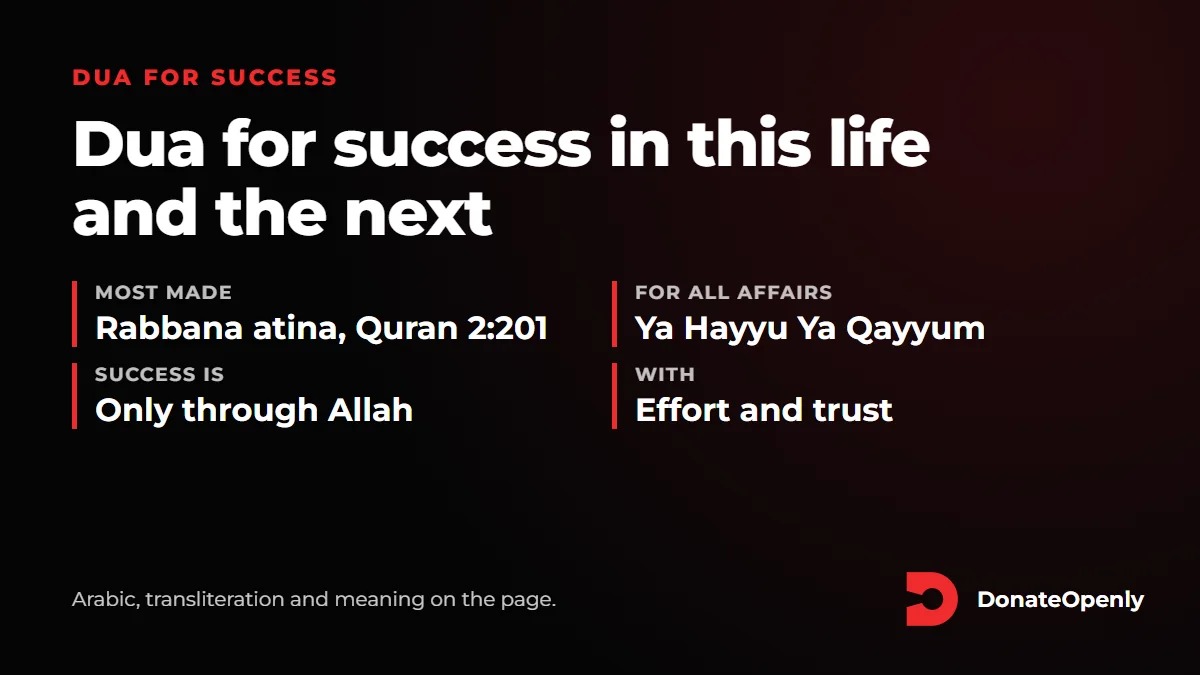
The best dua for success in this life and the next
وَمِنۡهُم مَّن يَقُولُ رَبَّنَآ ءَاتِنَا فِي ٱلدُّنۡيَا حَسَنَةٗ وَفِي ٱلۡأٓخِرَةِ حَسَنَةٗ وَقِنَا عَذَابَ ٱلنَّارِ ٢٠١
wamin'hum man yaqūlu rabbanā ātinā fī l-dun'yā ḥasanatan wafī l-ākhirati ḥasanatan waqinā ʿadhāba l-nāri
But among them is he who says, "Our Lord, give us in this world [that which is] good and in the Hereafter [that which is] good and protect us from the punishment of the Fire."
Anas ibn Malik said this was the dua the Prophet ﷺ made most often (Sahih al-Bukhari and Sahih Muslim). In a few words it asks for every kind of good: health, family, provision and knowledge in this life, and forgiveness and Paradise in the next.
Kamyabi ki dua
Kamyabi means success in Urdu, and this is the kamyabi ki dua most teachers give first. In Roman Urdu: “Aye hamare Rab, hamein duniya mein bhi bhalai de aur aakhirat mein bhi bhalai de, aur hamein aag ke azaab se bacha.” See more on the Rabbana atina dua.
Dua for success in everything
((يَا حَيُّ يَا قَيُّومُ بِرَحْمَتِكَ أَسْتَغيثُ أَصْلِحْ لِي شَأْنِيَ كُلَّهُ وَلاَ تَكِلْنِي إِلَى نَفْسِي طَرْفَةَ عَيْنٍ)).
(Ya hayyu ya qayyoom, birahmatika astagheeth, aslih lee sha/nee kullah, wala takilnee ila nafsee tarfata AAayn.)
(O Ever Living, O Self-Subsisting and Supporter of all, by Your mercy I seek assistance, rectify for me all of my affairs and do not leave me to myself, even for the blink of an eye.)
((أَصْبَحْنَا وَأَصْبَحَ الْمُلْكُ لِلَّهِ رَبِّ الْعَالَمِينَ، اللَّهُـمَّ إِنِّي أَسْأَلُكَ خَيْرَ هَذَا الْيَوْمِ:فَتْحَهُ، وَنَصْرَهُ، وَنورَهُ، وَبَرَكَتَهُ، وَهُدَاهُ، وَأَعُوذُ بِكَ مِنْ شَرِّ مَا فِيهِ وَشَرِّ مَا بَعْدَهُ)). [وإذا أمسى قال: أمسينا وأمسى الملك للَّه ربّ العالمين اللَّهم إني أسألك خير هذه الليلة: فتحها، ونصرها، ونورها، وبركتها، وهداها، وأعوذ بك من شر ما فيها، وشر ما بعدها.]
(Asbahna wa-asbahal-mulku lillahi rabbil-AAalameen, allahumma innee as-aluka khayra hathal-yawm, fat-hahu, wanasrahu, wanoorahu, wabarakatahu, wahudahu, wa-aAAoothu bika min sharri ma feehi, washarri ma baAAdah.)[For the evening, the supplication is read as follows: ](Amsayna wa-amsal-mulku lillahi rabbil-AAalameen, allahumma innee as-aluka khayra hathihil-laylah, fat-haha, wanasraha, wanooraha, wabarakataha, wahudaha, wa-aAAoothu bika min sharri ma feeha washarri ma baAAdaha.)
(We have reached the morning and at this very time all sovereignty belongs to Allah, Lord of the worlds. O Allah, I ask You for the good of this day, its triumphs and its victories, its light and its blessings and its guidance, and I take refuge in You from the evil of this day and the evil that follows it.)[For the evening, the supplication is read as follows:](We have reached the evening and at this very time all sovereignty belongs to Allah, Lord of the worlds. O Allah, I ask You for the good of tonight, its triumphs and its victories, its light and its blessings and its guidance, and I take refuge in You from the evil of tonight and the evil that follows it.)
The first asks Allah to set right all of your affairs and not leave you to yourself for the blink of an eye. The second, from the morning adhkar, asks for the good of the day: its openings, its victories, its light, its blessings and its guidance.
My success is only through Allah
When the prophet Shu‘ayb spoke to his people, he said: “And my success is not but through Allah. Upon Him I have relied, and to Him I return” (Surah Hud 11:88). Many Muslims say “wa ma tawfiqi illa billah” before starting any task: whatever skill and effort I bring, the result is from Allah.
Effort and dua together
((قَدَرُ اللَّهُ وَمَا شَاءَ فَعَلَ)).
(Qaddaral-lah, wama shaa faAAal.)
(Allah has decreed and what He wills, He does.)(for verily ‘If’ lets in the work of the devil.)
The Prophet ﷺ said: be eager for what benefits you, seek help from Allah, and do not give up. If something befalls you, do not say “if only I had done this”, but say “Allah decreed, and He does what He wills” (Sahih Muslim). That is the Islamic way to success: plan, work hard, ask Allah, and accept what He decides.
Duas for success in particular things
- Exams and study: see the dua for exams and duas for studying.
- A job interview: see the dua for interview success.
- Work and business: see the dua for business success.
- A need of any kind: see dua e hajat.
What success means in the Quran
قَدۡ أَفۡلَحَ ٱلۡمُؤۡمِنُونَ ١ ٱلَّذِينَ هُمۡ فِي صَلَاتِهِمۡ خَٰشِعُونَ ٢ وَٱلَّذِينَ هُمۡ عَنِ ٱللَّغۡوِ مُعۡرِضُونَ ٣ وَٱلَّذِينَ هُمۡ لِلزَّكَوٰةِ فَٰعِلُونَ ٤ وَٱلَّذِينَ هُمۡ لِفُرُوجِهِمۡ حَٰفِظُونَ ٥ إِلَّا عَلَىٰٓ أَزۡوَٰجِهِمۡ أَوۡ مَا مَلَكَتۡ أَيۡمَٰنُهُمۡ فَإِنَّهُمۡ غَيۡرُ مَلُومِينَ ٦ فَمَنِ ٱبۡتَغَىٰ وَرَآءَ ذَٰلِكَ فَأُوْلَٰٓئِكَ هُمُ ٱلۡعَادُونَ ٧ وَٱلَّذِينَ هُمۡ لِأَمَٰنَٰتِهِمۡ وَعَهۡدِهِمۡ رَٰعُونَ ٨ وَٱلَّذِينَ هُمۡ عَلَىٰ صَلَوَٰتِهِمۡ يُحَافِظُونَ ٩ أُوْلَٰٓئِكَ هُمُ ٱلۡوَٰرِثُونَ ١٠ ٱلَّذِينَ يَرِثُونَ ٱلۡفِرۡدَوۡسَ هُمۡ فِيهَا خَٰلِدُونَ ١١
qad aflaḥa l-mu'minūna alladhīna hum fī ṣalātihim khāshiʿūna wa-alladhīna hum ʿani l-laghwi muʿ'riḍūna wa-alladhīna hum lilzzakati fāʿilūna wa-alladhīna hum lifurūjihim ḥāfiẓūna illā ʿalā azwājihim aw mā malakat aymānuhum fa-innahum ghayru malūmīna famani ib'taghā warāa dhālika fa-ulāika humu l-ʿādūna wa-alladhīna hum li-amānātihim waʿahdihim rāʿūna wa-alladhīna hum ʿalā ṣalawātihim yuḥāfiẓūna ulāika humu l-wārithūna alladhīna yarithūna l-fir'dawsa hum fīhā khālidūna
Certainly will the believers have succeeded: They who are during their prayer humbly intent And they who turn away from ill speech And they who are observant of zakāh And they who guard their private parts Except from their wives or those their right hands possess, for indeed, they will not be blamed - But whoever seeks beyond that, then those are the transgressors - And they who are to their trusts and their promises attentive And they who carefully maintain their prayers - Those are the inheritors Who will inherit al-Firdaus. They will abide therein eternally.
Surah Al-Mu’minun opens with “Certainly will the believers have succeeded” and then names who they are: humble in prayer, turning away from idle talk, giving zakat, guarding their chastity, keeping their trusts and promises, and guarding their prayers. Their reward is al-Firdaus.
Elsewhere Allah says that whoever “is drawn away from the Fire and admitted to Paradise has attained [success]” (Surah Al-Imran 3:185). A good job and good grades are blessings; the success the Quran points to is the one that lasts.
Habits the Quran ties to success
- Prayer and worship: “bow and prostrate and worship your Lord and do good, that you may succeed” (22:77).
- Remembering Allah at work: after Jumuah, “seek from the bounty of Allah, and remember Allah often that you may succeed” (62:10).
- Generosity: “whoever is protected from the stinginess of his soul, it is those who will be the successful” (59:9).
- Patience and steadfastness: “persevere and endure… that you may be successful” (3:200).
- Purifying the self: “he has succeeded who purifies it” (91:9).
Written for DonateOpenly from the sources it cites, and awaiting review by ulama. Dates are worked out from the Islamic calendar and depend on the moon sighting.
Choose a charity, then give on its own website
Every registered UK Muslim charity has a page on DonateOpenly: what it does, where its work reaches people and where donors review it.
Dua for success: questions
What is the best dua for success?
“Rabbana atina fid-dunya hasanatan wa fil-akhirati hasanatan wa qina ‘adhaban-nar” (Quran 2:201). Anas said it was the dua the Prophet ﷺ made most often (Sahih al-Bukhari and Sahih Muslim).
What is a powerful dua for success in everything?
“Ya Hayyu Ya Qayyum, bi rahmatika astaghith, aslih li sha’ni kullahu wa la takilni ila nafsi tarfata ‘ayn”: O Ever-Living, O Sustainer, by Your mercy I seek help; set right all my affairs and do not leave me to myself for the blink of an eye.
Kamyabi ki dua kya hai?
Sab se mashhoor kamyabi ki dua “Rabbana atina fid-dunya hasanatan wa fil-akhirati hasanatan wa qina ‘adhaban-nar” hai (Quran 2:201): duniya aur aakhirat dono ki bhalai ki dua.
Is there a dua for success in life?
Yes. Rabbana atina asks for good in this life and the next, and “wa ma tawfiqi illa billah” (Quran 11:88) reminds you that success comes only from Allah. Say them while you work towards your goals.
Is there a dua that guarantees success?
No dua is a guarantee of a particular result. Allah answers every sincere dua, by giving what was asked, by saving its reward for the Hereafter, or by turning away a harm, as a hadith reported by Ahmad explains.
Can I make dua for worldly success?
Yes. Rabbana atina itself asks for good in this world. The Prophet ﷺ made dua for Anas that Allah increase his wealth and children and bless him in them (Sahih al-Bukhari and Sahih Muslim).