- Home
- Dua for Eid
The Islamic year
Dua for Eid: The Eid Greeting, the Takbir of Eid and Duas for Eid al-Fitr and Eid al-Adha
What the companions said to each other on Eid, the takbir of the two Eids, the dua at the sacrifice, and how to spend the day
The best-known dua for Eid is the greeting the companions of the Prophet ﷺ gave each other: “Taqabbalallahu minna wa minkum”, may Allah accept from us and from you. Jubayr ibn Nufayr reported that they said it when they met on the day of Eid, and Ibn Hajar graded the report’s chain as good. Eid is also a day of takbir: “Allahu akbar, Allahu akbar, la ilaha illallah, wallahu akbar, Allahu akbar, wa lillahil-hamd.” There is no special Eid prayer dua beyond these, but the day is full of dua: for acceptance of Ramadan or Hajj, for family and for the Ummah. This page gives the Eid greeting, the takbir, the dua for the Eid al-Adha sacrifice, and the Sunnah of the day.
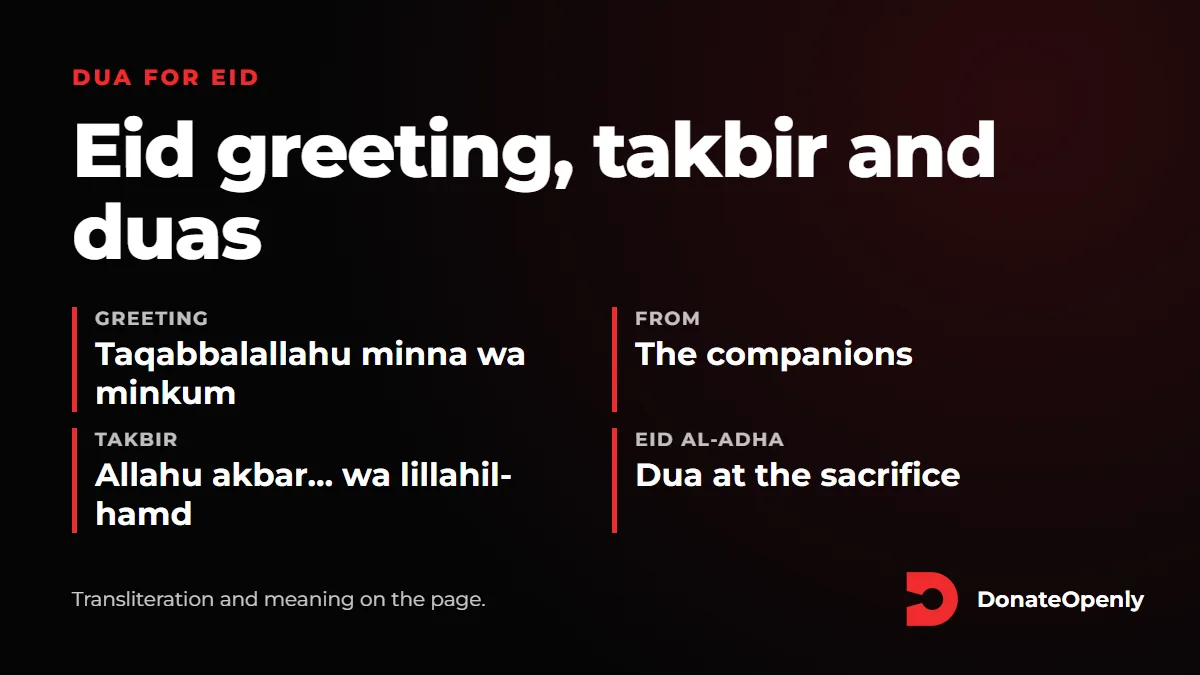
Eid dua: Taqabbalallahu minna wa minkum
- Taqabbalallahu: may Allah accept
- Minna wa minkum: from us and from you.
It asks Allah to accept the fasting of Ramadan or the deeds of the ten days of Dhul Hijjah, from you and from the person you greet. The usual reply is the same words, or “minna wa minkum”.
Dua for Eid Mubarak
“Eid Mubarak”, blessed Eid, is a later greeting used across the Muslim world. Scholars say there is no harm in it, as greetings follow custom; many say both: “Eid Mubarak, taqabbalallahu minna wa minkum.” See Eid Mubarak 2027.
The takbir of Eid
شَهۡرُ رَمَضَانَ ٱلَّذِيٓ أُنزِلَ فِيهِ ٱلۡقُرۡءَانُ هُدٗى لِّلنَّاسِ وَبَيِّنَٰتٖ مِّنَ ٱلۡهُدَىٰ وَٱلۡفُرۡقَانِۚ فَمَن شَهِدَ مِنكُمُ ٱلشَّهۡرَ فَلۡيَصُمۡهُۖ وَمَن كَانَ مَرِيضًا أَوۡ عَلَىٰ سَفَرٖ فَعِدَّةٞ مِّنۡ أَيَّامٍ أُخَرَۗ يُرِيدُ ٱللَّهُ بِكُمُ ٱلۡيُسۡرَ وَلَا يُرِيدُ بِكُمُ ٱلۡعُسۡرَ وَلِتُكۡمِلُواْ ٱلۡعِدَّةَ وَلِتُكَبِّرُواْ ٱللَّهَ عَلَىٰ مَا هَدَىٰكُمۡ وَلَعَلَّكُمۡ تَشۡكُرُونَ ١٨٥
shahru ramaḍāna alladhī unzila fīhi l-qur'ānu hudan lilnnāsi wabayyinātin mina l-hudā wal-fur'qāni faman shahida minkumu l-shahra falyaṣum'hu waman kāna marīḍan aw ʿalā safarin faʿiddatun min ayyāmin ukhara yurīdu l-lahu bikumu l-yus'ra walā yurīdu bikumu l-ʿus'ra walituk'milū l-ʿidata walitukabbirū l-laha ʿalā mā hadākum walaʿallakum tashkurūna
The month of Ramaḍān [is that] in which was revealed the Qur’ān, a guidance for the people and clear proofs of guidance and criterion. So whoever sights [the crescent of] the month, let him fast it; and whoever is ill or on a journey - then an equal number of other days. Allāh intends for you ease and does not intend for you hardship and [wants] for you to complete the period and to glorify Allāh for that [to] which He has guided you; and perhaps you will be grateful.
وَٱذۡكُرُواْ ٱللَّهَ فِيٓ أَيَّامٖ مَّعۡدُودَٰتٖۚ فَمَن تَعَجَّلَ فِي يَوۡمَيۡنِ فَلَآ إِثۡمَ عَلَيۡهِ وَمَن تَأَخَّرَ فَلَآ إِثۡمَ عَلَيۡهِۖ لِمَنِ ٱتَّقَىٰۗ وَٱتَّقُواْ ٱللَّهَ وَٱعۡلَمُوٓاْ أَنَّكُمۡ إِلَيۡهِ تُحۡشَرُونَ ٢٠٣
wa-udh'kurū l-laha fī ayyāmin maʿdūdātin faman taʿajjala fī yawmayni falā ith'ma ʿalayhi waman ta-akhara falā ith'ma ʿalayhi limani ittaqā wa-ittaqū l-laha wa-iʿ'lamū annakum ilayhi tuḥ'sharūna
And remember Allāh during [specific] numbered days. Then whoever hastens [his departure] in two days - there is no sin upon him; and whoever delays [until the third] - there is no sin upon him - for him who fears Allāh. And fear Allāh and know that unto Him you will be gathered.
The common wording, reported from Ibn Mas‘ud and other companions, is “Allahu akbar, Allahu akbar, la ilaha illallah, wallahu akbar, Allahu akbar, wa lillahil-hamd”: Allah is the greatest, Allah is the greatest, none is worthy of worship but Allah; Allah is the greatest, Allah is the greatest, and to Allah belongs all praise.
- Eid al-Fitr: the verse of fasting ends “that you glorify Allah for having guided you”. The takbir is said from the sighting of the moon, or from leaving home for the prayer, until the imam begins, by the different views of the schools.
- Eid al-Adha: Allah says, “remember Allah during numbered days”. The takbir is said from Fajr on the Day of Arafah until ‘Asr on the 13th of Dhul Hijjah, especially after each fard prayer; the schools differ a little on the start and end.
Men say it aloud in the streets and masjids; women say it more quietly. See takbeerat al-Eid for its wordings.
Dua for Eid al-Adha: the sacrifice
((بِسْمِ اللَّهِ وَاللَّهُ أَكْبَرُ [اللَّهُمَّ مِنْكَ وَلَكَ] اللَّهُمَّ تَقَبَّلْ مِنِّي)).
(Bismil-lah wallahu akbar, allahumma minka walak, allahumma taqabbal minnee.)
(In the name of Allah, and Allah is the greatest. O Allah, (it is) from You and belongs to You, O Allah, accept this from me.)
فَصَلِّ لِرَبِّكَ وَٱنۡحَرۡ ٢
faṣalli lirabbika wa-in'ḥar
So pray to your Lord and offer sacrifice [to Him alone].
When slaughtering the qurbani, the Prophet ﷺ said: Bismillah, Allahu akbar; O Allah, this is from You and for You; O Allah, accept it from me. If someone slaughters on your behalf, they may add your name: “accept it from so-and-so”. See Qurbani 2027.
The Day of Arafah
The day before Eid al-Adha is the Day of Arafah, the best day for dua in the year. See the Day of Arafah 2027.
The Sunnah of the day of Eid
- Bathe and wear your best clothes: the companions did so for Eid.
- Eid al-Fitr: eat an odd number of dates before going to the prayer (Sahih al-Bukhari), and pay zakat al-fitr before the prayer.
- Eid al-Adha: delay eating until after the prayer, and eat from your sacrifice if you offered one.
- Take a different route back: the Prophet ﷺ went to the Eid prayer by one road and returned by another (Sahih al-Bukhari).
- Visit family and give gifts: a day of joy, food and kindness, especially to children, orphans and those alone.
Duas to make on Eid
Ask Allah to accept your Ramadan or your Hajj and sacrifice, to let you reach the next Eid in good health and faith, to forgive those who have died since last Eid, and to relieve Muslims who are suffering. Rabbana atina, the Prophet’s most frequent dua, is a good place to start.
Written for DonateOpenly from the sources it cites, and awaiting review by ulama. Dates are worked out from the Islamic calendar and depend on the moon sighting.
Choose a charity, then give on its own website
Every registered UK Muslim charity has a page on DonateOpenly: what it does, where its work reaches people and where donors review it.
Dua for Eid: questions
What is the dua for Eid?
The companions greeted each other on Eid with “Taqabbalallahu minna wa minkum”, may Allah accept from us and from you. Ibn Hajar graded the report of Jubayr ibn Nufayr good.
What is the takbir of Eid?
“Allahu akbar, Allahu akbar, la ilaha illallah, wallahu akbar, Allahu akbar, wa lillahil-hamd”, reported from Ibn Mas‘ud and other companions, and based on the command to glorify Allah in Quran 2:185 and 2:203.
What do you reply to Eid Mubarak?
Reply “Eid Mubarak”, or “Khair Mubarak”, or with the companions’ words, “Taqabbalallahu minna wa minkum”.
Is there a special dua for Eid al-Adha?
The dua at the sacrifice: “Bismillah, Allahu akbar, Allahumma minka wa lak, Allahumma taqabbal minni”, from Hisn al-Muslim. The takbir is said through the days of Eid al-Adha.
Is there a special dua in the Eid prayer?
No special dua is fixed for the Eid prayer. It has extra takbirs, which the schools count differently, and the imam gives a khutbah after it; the rest of the day is open for your own duas.