- Home
- Barakallahu feekum
Islam basics
Barakallahu Feekum Meaning: What Does Barakallahu Feek Mean, and How Do You Reply?
“May Allah bless you”: the words, their forms, the reply ‘A’ishah gave, and the Sunnah duas of blessing for weddings and gifts
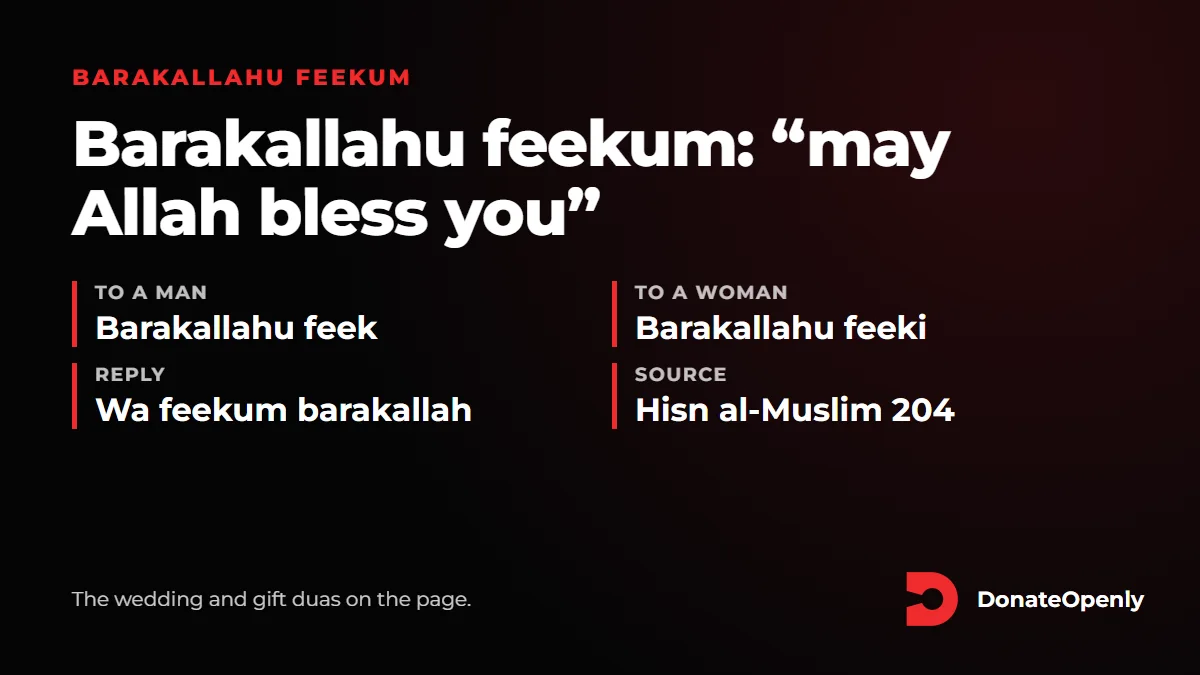
Barakallahu feekum means “may Allah bless you”, said to a group or politely to one person; barakallahu feek is the form for one man and barakallahu feeki for one woman. Muslims say it to thank someone, to congratulate them, or when they admire something they have. In the Sunnah, when people said barakallahu feekum to the Prophet’s household, ‘A’ishah replied “wa feehim barakallah”, and may Allah bless them too.
Barakallahu feekum meaning
- Baraka: may He bless. Barakah is lasting good that grows: a little that does a lot, and good that stays.
- Allahu: Allah.
- Fee: in.
- Kum: you (all).
So barakallahu feekum is “may Allah put blessing in you”, or simply “may Allah bless you”.
Barakallahu feek, feeki or feekum?
- Barakallahu feek: to one man.
- Barakallahu feeki: to one woman.
- Barakallahu feekuma: to two people.
- Barakallahu feekum: to a group, or to one person as a mark of respect.
Barakallahu laka (or laki) means “may Allah bless it for you”, and is said about something a person has been given.
Barakallahu feekum in the Sunnah
((وَفِيكَ بَارَكَ اللَّهُ)).
(Aaishah reported that the Messenger of Allah was given a sheep and he ordered for it’s distribution. When the servant would come back (from distributing it), AAaishah would ask: ‘What did they say?’, he replied: They would supplicate: (Barakal-lahu feekum.) AAaishah would then say: (Wafeehim barakal-lah.))(we return their supplication in a similar way and our reward remains with us.)
(Aaishah reported that the Messenger of Allah was given a sheep and he ordered for it’s distribution. When the servant would come back (from distributing it), AAaishah would ask: ‘What did they say?’, he replied: They would supplicate: (May Allah bless you all.) AAaishah would then say: (and may Allah bless them.))(we return their supplication in a similar way and our reward remains with us.)
The Prophet ﷺ was given a sheep and had it shared out. When the servant came back, ‘A’ishah asked what people had said, and he told her they had said “barakallahu feekum”. She replied: “wa feehim barakallah”, and may Allah bless them.
Scholars note the lesson in her answer: she returned their dua with the same dua, so the reward of the gift stayed whole with those who gave it.
How to reply to barakallahu feekum
- Wa feekum barakallah: and may Allah bless you too. The same reply ‘A’ishah gave.
- Wa feek barakallah: to one man; wa feeki barakallah to one woman.
- Ameen: accepting the dua.
- Jazakallahu khayran: may Allah reward you with good. See jazakallah meaning.
Barakallah or jazakallah?
Both are duas used for thanks. Jazakallahu khayran asks Allah to reward someone for what they did; barakallahu feek asks Allah to bless the person and what they have. Many people say both.
When to say barakallah: weddings, gifts and good news
((بَارَكَ اللَّهُ لَكَ، وَبَارَكَ عَلَيْكَ، وَجَمَعَ بَيْنَكُمَا فِي خَيْرٍ)).
(Barakal-lahu lak, wabaraka AAalayk, wajamaAAa baynakuma fee khayr.)
(May Allah bless for you (your spouse) and bless you, and may He unite both of you in goodness.)
((بَارَكَ اللَّهُ لَكَ فِي أَهْلِكَ وَمَالِكَ)).
(Barakal-lahu laka fee ahlika wamalik.)
(May Allah bless for you, your family and wealth.)
- At a wedding: “Barakallahu laka, wa baraka ‘alayka, wa jama‘a baynakuma fi khayr”, may Allah bless you, shower blessing on you and join you both in good (first dua above).
- When someone shares their wealth with you: “Barakallahu laka fi ahlika wa malik”, may Allah bless you in your family and your wealth (second dua above). It is said too when repaying a loan.
- At a new baby: Hisn al-Muslim gives a dua of congratulation that begins “barakallahu laka fil-mawhubi lak”, may Allah bless you in the one He has given you.
- When you admire something: the Sunnah is to ask Allah to bless it for its owner. See mashallah meaning.
- As thanks: for a kindness, a meal or help with anything.
Written for DonateOpenly from the sources it cites, and awaiting review by ulama. Dates are worked out from the Islamic calendar and depend on the moon sighting.
Choose a charity, then give on its own website
Every registered UK Muslim charity has a page on DonateOpenly: what it does, where its work reaches people and where donors review it.
Barakallahu feekum: questions
What does barakallahu feekum mean?
Barakallahu feekum means “may Allah bless you”. It is said to a group, or to one person as a mark of respect.
How do you reply to barakallahu feekum?
Say “wa feekum barakallah”, and may Allah bless you too. When people said barakallahu feekum, ‘A’ishah replied “wa feehim barakallah” (Hisn al-Muslim 204).
What is the difference between barakallahu feek and barakallahu feekum?
Barakallahu feek is to one man and feeki to one woman. Feekum is to a group, or a respectful way of speaking to one person.
What do you say to a newly married couple?
“Barakallahu laka, wa baraka ‘alayka, wa jama‘a baynakuma fi khayr”: may Allah bless you, shower blessing on you and join you both in good (Hisn al-Muslim 190).
Is barakallah the same as jazakallah?
They are close. Jazakallahu khayran asks Allah to reward someone for what they did; barakallahu feek asks Allah to bless them.
Is barakallah the same as mashallah?
No. Mashallah means “what Allah has willed” and recognises a blessing. Barakallah is a dua that Allah bless it; the Sunnah is to say it when you admire something.