- Home
- Ayat e karima
The Quran
Ayat e Karima: the Dua of Prophet Yunus From Surah Al-Anbiya 21:87, Its Meaning and When to Read It
La ilaha illa anta subhanaka inni kuntu minaz-zalimin: the words, the story of Yunus in the whale, the promise and how to read it
Ayat e karima (ayat al-karima, “the noble verse”) is the dua Prophet Yunus (Jonah), peace be upon him, made from inside the whale: La ilaha illa anta subhanaka inni kuntu minaz-zalimin, “There is no god but You; glory be to You; I have been one of the wrongdoers.” It comes from Surah Al-Anbiya, verse 87. The Prophet ﷺ said that no Muslim calls on Allah with it for anything without Allah answering him. Here are its words, its meaning, its story and how Muslims read it.
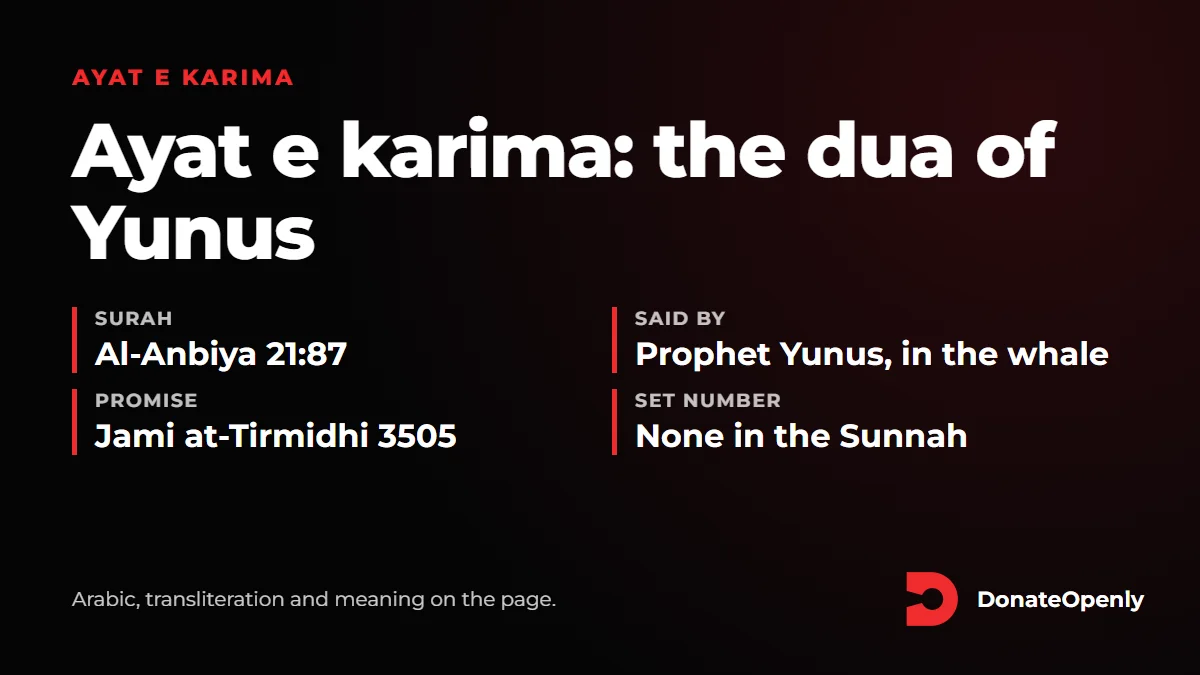
Ayat e karima in the Quran: Surah Al-Anbiya 21:87
وَذَا ٱلنُّونِ إِذ ذَّهَبَ مُغَٰضِبٗا فَظَنَّ أَن لَّن نَّقۡدِرَ عَلَيۡهِ فَنَادَىٰ فِي ٱلظُّلُمَٰتِ أَن لَّآ إِلَٰهَ إِلَّآ أَنتَ سُبۡحَٰنَكَ إِنِّي كُنتُ مِنَ ٱلظَّٰلِمِينَ ٨٧ فَٱسۡتَجَبۡنَا لَهُۥ وَنَجَّيۡنَٰهُ مِنَ ٱلۡغَمِّۚ وَكَذَٰلِكَ نُـۨجِي ٱلۡمُؤۡمِنِينَ ٨٨
wadhā l-nūni idh dhahaba mughāḍiban faẓanna an lan naqdira ʿalayhi fanādā fī l-ẓulumāti an lā ilāha illā anta sub'ḥānaka innī kuntu mina l-ẓālimīna fa-is'tajabnā lahu wanajjaynāhu mina l-ghami wakadhālika nunjī l-mu'minīna
And [mention] the man of the fish [i.e., Jonah], when he went off in anger and thought that We would not decree [anything] upon him. And he called out within the darknesses, "There is no deity except You; exalted are You. Indeed, I have been of the wrongdoers." So We responded to him and saved him from the distress. And thus do We save the believers.
The words Muslims call ayat e karima are the dua inside verse 87. Verse 88 is Allah’s answer: He saved Yunus, and “thus do We save the believers”.
Ayat e karima transliteration
La ilaha illa anta subhanaka inni kuntu minaz-zalimin.
Ayat e karima meaning in English
“There is no deity except You; exalted are You. Indeed, I have been of the wrongdoers.” In plainer words: there is no god but You, You are free of every fault, and the fault was mine.
Ayat e karima in Hindi
ला इलाहा इल्ला अन्ता सुब्हानका इन्नी कुन्तु मिनज़्ज़ालिमीन
The story behind ayat e karima
Yunus was sent to a great city of “a hundred thousand or more” (As-Saffat 37:147). When his people would not listen, he left them in anger before Allah gave him leave to go (Al-Anbiya 21:87).
- The ship: he boarded a laden ship; lots were drawn, and he was the one cast into the sea (37:140-141).
- The whale: a great fish swallowed him (37:142). He called out “within the darknesses”, which scholars of tafsir explain as the darkness of the night, of the sea and of the whale’s belly.
- The rescue: “had he not been of those who exalt Allah, he would have remained inside its belly until the Day they are resurrected” (37:143-144). He was cast onto the shore, ill, and Allah grew a gourd vine over him.
- His people: they believed, and theirs was the one city whose belief at the last moment saved it (Yunus 10:98).
Be patient, not like the companion of the fish
Surah Al-Qalam tells the Prophet ﷺ to be patient and not like “the companion of the fish” who called out in distress (68:48). The lesson is for us too: wait on Allah’s decision, and when we slip, return to Him at once, as Yunus did.
Why ayat e karima is so powerful
The dua has three parts, and each is a door to Allah’s mercy:
- La ilaha illa anta: there is no god but You. Tawhid, the heart of Islam, comes first.
- Subhanaka: glory be to You. Allah is free of all injustice, so the hardship is not a wrong done to us.
- Inni kuntu minaz-zalimin: I have been one of the wrongdoers. An honest confession, with no excuse.
Notice that Yunus asked for nothing directly. He praised Allah and admitted his fault, and that was enough. Scholars point to this as a model of humble asking.
The promise in the hadith
The Prophet ﷺ called it the dua of Dhun-Nun (“the man of the fish”) and said that no Muslim makes it for anything without Allah answering him (Jami at-Tirmidhi 3505). Hisn al-Muslim lists it among the duas for times of anguish.
When and how to read ayat e karima
((لاَ إِلَهَ إِلاَّ أَنْتَ سُبْحَانَكَ إِنِّي كُنْتُ مِنَ الظّالِمِينَ)).
(La ilaha illa anta subhanaka innee kuntu minath-thalimeen.)
(None has the right to be worshipped except You. How perfect You are, verily I was among the wrong-doers.)
Ayat e karima can be said at any time, in any number, in any place where dhikr is fitting. Muslims turn to it most:
- In distress: worry, grief, fear, or a closed door with no way out.
- After a sin: as part of tawbah, admitting the wrong to Allah alone.
- In illness or hardship: alongside treatment and effort, never instead of them.
- In the last part of the night and after salah: times when duas are hoped to be answered.
The sawa lakh (125,000) gathering
In South Asia some families gather to read ayat e karima 125,000 times together. That number is a custom; it does not come from the Quran or the Sunnah, and scholars differ about such gatherings. The dua itself is complete when said once with a present heart, and it can be repeated as often as you like.
Read it with its meaning
Say it slowly and mean each part: His oneness, His perfection, your fault. A few times with full attention is closer to what Yunus did than many times with the mind elsewhere.
Written for DonateOpenly from the sources it cites, and awaiting review by ulama. Dates are worked out from the Islamic calendar and depend on the moon sighting.
Choose a charity, then give on its own website
Every registered UK Muslim charity has a page on DonateOpenly: what it does, where its work reaches people and where donors review it.
Ayat e karima: questions
What is ayat e karima?
Ayat e karima is the dua of Prophet Yunus: La ilaha illa anta subhanaka inni kuntu minaz-zalimin, “There is no god but You; glory be to You; I have been one of the wrongdoers.”
Ayat e karima is in which surah?
It is in Surah Al-Anbiya, the 21st surah, verse 87, in the 17th para of the Quran.
What is the virtue of ayat e karima?
The Prophet ﷺ said: “The supplication of Dhun-Nun… no Muslim man supplicates with it for anything except that Allah answers him” (Jami at-Tirmidhi 3505). Allah also says after it: “thus do We save the believers” (Quran 21:88).
How many times should I read ayat e karima?
No fixed number comes from the Prophet ﷺ. Read it once or many times, with attention to its meaning; the 125,000 count is a custom, not a Sunnah.
Is it ayat al karima or ayat ul karima?
Ayat e karima, ayat al karima, ayat ul karima and ayat-e-kareema are all spellings of the same name, “the noble verse”.
Can I read ayat e karima for exams, illness or a wish?
Yes. It is a dua for any need, especially in hardship. Make the effort too: study, seek treatment and take the means Allah has given you.